




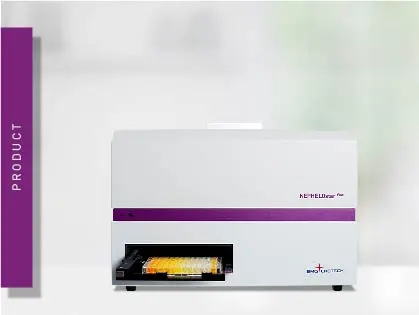
NEPHELOstar Plus
Microplate nephelometer for light-scattering and turbidity measurements
 What is a nephelometer?
A nephelometer is an instrument used to measure the concentration of suspended particles in a liquid or gas by detecting how much light they scatter. It works by directing a light source through a sample, with a detector positioned at a right angle to the beam and an optical light scattering collector in between. Because it is designed exclusively for this purpose, a nephelometer is a standalone instrument - unlike multi-mode plate readers, it can only detect scattered light.
As the light beam passes through the sample, its interaction with particles determines the signal generated. If no particles are present, the light travels straight through without scattering, resulting in little to no detectable signal. However, when particles are present, they scatter the incoming light in multiple directions. This scattered light is captured by a collector - often an integrating device such as an Ulbricht sphere - which reflects and diffuses the light internally before directing it toward a photodiode detector. The intensity of the detected signal corresponds to the degree of light scattering within the sample.
In liquid samples, there is typically a linear relationship between particle concentration and the intensity of scattered light across a broad concentration range. This allows nephelometers to quantify particle concentration with high sensitivity. However, the scattering signal is influenced not only by concentration but also by particle characteristics such as size, shape, colour, and refractive index, which can affect measurement accuracy and interpretation.
For environmental and water quality applications, nephelometers are commonly used to measure turbidity, expressed in Nephelometric Turbidity Units (NTU). While calibrated nephelometers provide reliable turbidity measurements, the process can be relatively time-consuming and often requires multiple preparation steps and larger sample volumes compared to more rapid or high-throughput analytical methods.
Do you want to use a Nephelometer in your lab?
Request a quote or more information here:
 Which assays is a nephelometer used for?
In life sciences, nephelometers are mainly used in pharmaceutical labs to test the solubility of drugs, also in automated screenings. In biochemical labs, the main applications of a nephelometer include protein-protein interaction, protein aggregation, and polymerization studies. In immunology, nephelometric detection has its main application in the development of new antibodies and the analysis of their binding capability to antigens.
The flexibility and performance of the NEPHELOstar Plus allow more applications to be adapted to microplate-based laser nephelometry than ever before. These include as well, flocculation assays, and bacterial and fungal growth kinetics.
Nephelometry is widely used in drug discovery to assess compound solubility at scale. Determining aqueous solubility early in the discovery process is critical, as it helps avoid progressing poorly soluble compounds into time-consuming and costly ADME studies. When such compounds precipitate in solution, they scatter light, producing a measurable signal that can be rapidly detected.
This makes nephelometers particularly well suited to high-throughput screening workflows, where hundreds or thousands of compounds must be evaluated efficiently. The light scattering approach has been shown to generate results comparable to traditional HPLC-based solubility measurements, while offering significantly higher throughput. In addition, nephelometry is largely unaffected by coloured solutions, which can interfere with absorbance-based methods.
In microbiology, nephelometers enable real-time monitoring of cell density by measuring light scattering caused by microbial growth. As bacteria or fungi proliferate, the increasing number of suspended cells leads to higher scattering intensity, allowing researchers to generate detailed growth curves in a rapid and non-destructive manner.
Continuous nephelometric monitoring is particularly valuable for evaluating antimicrobial activity. By tracking changes in scattering over time, researchers can assess how antimicrobial compounds influence growth kinetics. For example, the presence of inhibitory drugs often extends the lag phase of microbial growth, an early-stage effect that nephelometry can detect with high sensitivity. Compared to traditional photometric methods, nephelometry provides more precise insight into these early growth dynamics, making it especially useful for antimicrobial testing, fermentation monitoring, and optimization of culture conditions.
In clinical chemistry, immunonephelometric assays are used to determine the concentration of serum immunoglobulins (IgA, IgG, lgM), complement components (C3, C4), acute phase reactant proteins (CRP, transferrin), albumin, and alpha-1-antitrypsin. Protein precipitation of globular proteins refers to the formation of protein aggregates by adding e.g., salt or organic solvent. In contrast, immunoprecipitation allows a given protein to be precipitated selectively via an antibody-antigen reaction.
Nephelometry is widely used to monitor polymerisation and aggregation processes by detecting changes in particle size and concentration over time. As small molecules or monomers combine to form larger macromolecular structures, the resulting increase in particle size leads to greater light scattering, which can be measured in real time. This makes nephelometry particularly useful for tracking the kinetics of polymerisation reactions and identifying key transition points such as nucleation and growth phases.
In organic and polymer chemistry, this approach enables the quantification of macromolecule formation without the need for invasive sampling or complex separation techniques. Similarly, in biochemistry and biopharmaceutical development, nephelometry is used to study protein aggregation, a critical factor influencing the stability, efficacy, and safety of biologic drugs. By providing a sensitive and continuous readout of aggregation behaviour, nephelometry supports both process optimisation and quality control.
Nephelometers are a standard tool for measuring turbidity in water, reported in Nephelometric Turbidity Units (NTU). This is critical for assessing drinking water quality, wastewater treatment efficiency, and environmental conditions. Although highly reliable, these measurements typically require careful calibration and controlled sample handling to ensure accuracy.
 What to consider when choosing a nephelometer?
If you are on the market for a nephelometer or turbidimeter, there are a few factors to take into account, as performance can significantly affect the quality of your research data.
Scattering can be measured both by nephelometry and turbidimetry. Although these two terms are used sometimes as synonyms, technically they are not, as mentioned above. Turbidimetry is basically an absorbance measurement and can be performed on an absorbance microplate reader (turbidimeter). For measuring nephelometry (direct scattering), a dedicated nephelometer is needed.
When developing a scattering method, the instrument choice between nephelometer and turbidimeter is determined by two factors. The most important consideration is sensitivity. If the sample contains a small concentration of scattering particles, then a nephelometer is the best choice. A turbidimeter is a fitting choice when samples have a high concentration of scattering particles.
Secondly, the size of the scattering particles has to be considered. Generally, nephelometers are better suited for measuring scattering of small particles (< 1 µm), as the intensity of scattered light at 90° increases. Particle size is less important for turbidimeters, as the decrease in transmitted light is measured.
Spectrophotometry is best suited to dissolved substances that change absorbance at a specific wavelength. A nephelometer, by contrast, is designed for samples containing insoluble particles, precipitates, or cell suspensions that scatter light rather than absorb it. In practice, spectrophotometers can sometimes be used for scattering-based measurements, but they are not as sensitive to low levels of particulate matter as a dedicated nephelometer.
When choosing between the two, the key factor is the sample type. If the analyte is dissolved and you need a wavelength-dependent absorbance reading, a spectrophotometer is the better choice. If the sample contains small or low-concentration particles and the goal is to detect early scattering changes, nephelometry is more appropriate.
For that reason, nephelometry is often preferred in applications such as solubility screening, immunoassays, and microbial growth monitoring, where subtle particle formation matters more than absorbance. Spectrophotometry remains the standard method for many routine quantitative assays involving coloured or UV-absorbing compounds.
Though a nephelometer is a single-purpose instrument, flexibility should be anyway considered. This relates mainly to the light beam, as this plays a major role when measuring scattering. An exclusive feature of the NEPHELOstar Plus is the adjustable intensity and beam diameter of the laser light source.
In a nephelometer, the ability to adjust the intensity of the laser beam improves sensitivity and provides the best performance. With a narrow beamwidth, liquid surface effects such as a strong meniscus are reduced. Moreover, it allows better performance in high-density microplates up to 384 wells.
Depending on the assay, precise temperature control, multi-mode shaking capabilities, and atmospheric control or a gas vent could be beneficial.
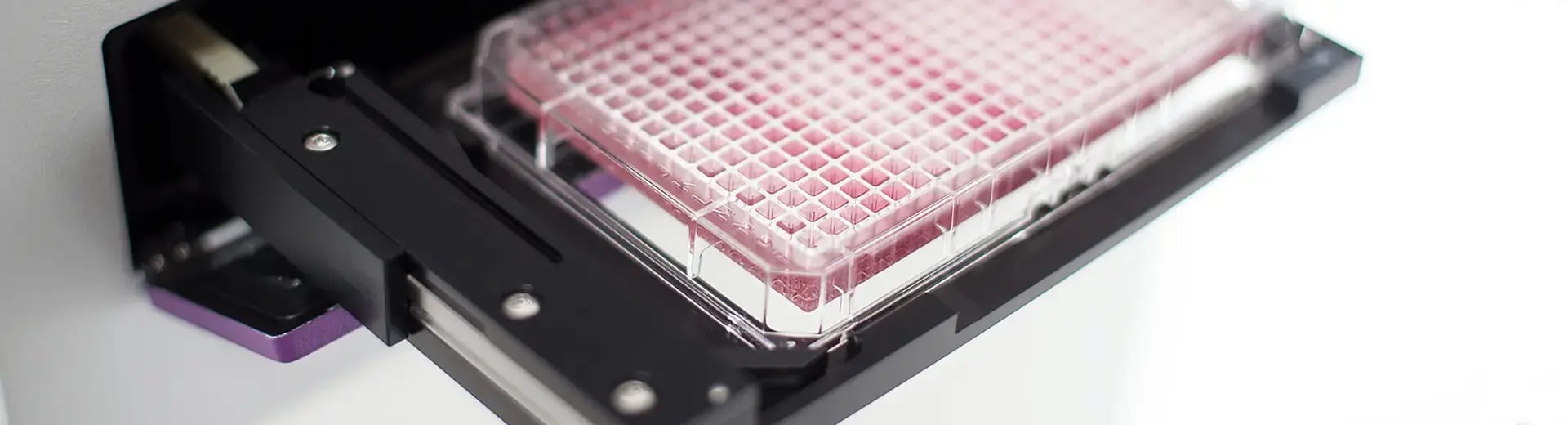
Commonly nephelometric assays are measured in 96 well microplates. However, if you have multiple samples and/or wish to save precious reagents or time, 384 well plates can also be used. Since scattering can also be caused by dust, dirt, or scratches on the bottom of a well, microplates used for nephelometry have to be treated with extreme care.
Depending on the nature of the assay you want to run, the availability of reagent injectors on a nephelometer could be beneficial. By manually pipetting reagents into the wells, you can run the risk of losing important data about your reaction. Especially for fast responses, the event you are looking for may already be gone before the nephelometer can detect it.
 Introducing NEPHELOstar Plus
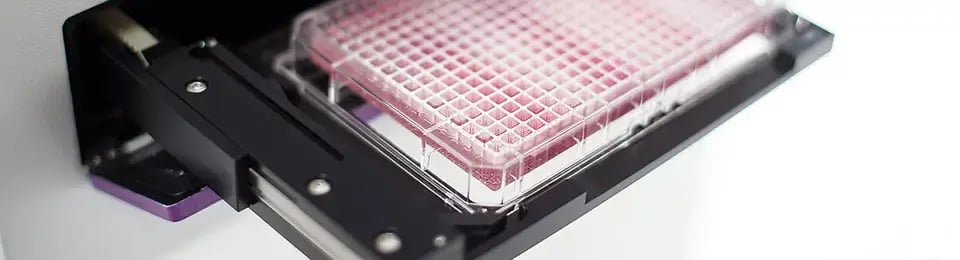
Nephelometry-based detection can be performed on the NEPHELOstar Plus - the world’s only laser-based microplate nephelometer. Our instrument has features that enable it to outperform microplate nephelometers:
The NEPHELOstar Plus uses a laser light source rather than a standard lamp, which helps deliver highly sensitive and stable nephelometric readings. Its adjustable laser intensity and beam diameter also make it more flexible across different sample types and assay conditions.
This instrument is built for microplate formats, making it a strong fit for automated and high-throughput workflows. That makes it especially useful when many samples need to be measured quickly and consistently.
Scattered light is collected using an Ulbricht sphere, which captures light over a wide angle before directing it to the detector. This improves signal quality and helps the instrument detect subtle scattering changes more reliably.
Because it measures scattered light directly, the NEPHELOstar Plus can outperform basic turbidimetry methods. This makes it more suitable for applications where sensitivity and precision matter, such as drug solubility screening, microbial growth monitoring, and protein interaction studies.
The instrument is well suited to workflows that require reproducible results and efficient analysis. Its optical design helps reduce interference and improve performance in complex samples, which is one reason it is commonly used for nephelometry-based applications.
Do you want more information about our NEPHELOstar plus?
Visit our detailed product page for more information here:


 BMG LABTECH is specialised in producing microplate readers only and brings more than 30 years of full expertise in plate reading technology. This knowledge gets visible in the results that our instruments deliver - the only factor that counts in your lab! BMG LABTECH users can trust to obtain best results in sensitivity, speed and flexibility. Moreover, our multi-mode microplate readers are developed to provide optimum performance for years. Our instruments are developed, produced and tested in Germany and are built to be extremely robust and reliable.
Due to their modularity, all our fluorescence plate readers can be equipped with different detection modes and cover a multitude of applications. Additional features can be upgraded at any time. This gives you the chance to keep your options open even if you don’t use the full scope of your microplate reader right at the bat.
We strive to provide you with the very best customer service. All sales area representatives are highly trained technical specialists able to support both the hardware, software and most application questions. For the most complex applications solutions a team of dedicated application specialists are also available.
All our instruments come with a multi-user software package that can be installed on as many computers as users require, without the need to purchase licenses. Software updates for our microplate readers are of no charge within the first 12 months after purchase.