microplate-reader-header microplate-reader-header-mobile

The HTRF plate reader trusted by drug-discovery labs

Homogeneous Time-Resolved Fluorescence (HTRF®) measurements are essential for many applications in drug discovery and screening. Explore in detail how our microplate readers can support your research.

Choose the PHERAstar FSX microplate reader for reliable, fast and sensitive HTRF measurements

  • Best-in-class Z′ and ΔF% - screen compounds with fewer false positives and tighter replicates
  • HTRF-certified and validated on both white and black microplates
  • Dedicated 337 nm laser + high-sensitivity PMTs - read the faintest TR-FRET signal in HTS
  • Simultaneous detection of donor and acceptor gives speed and precision
  • Supporting microplate formats from 96 to 3,456-well plates for assay miniaturization
  • Best microplate reader for HTRF-based kinetic binding assays
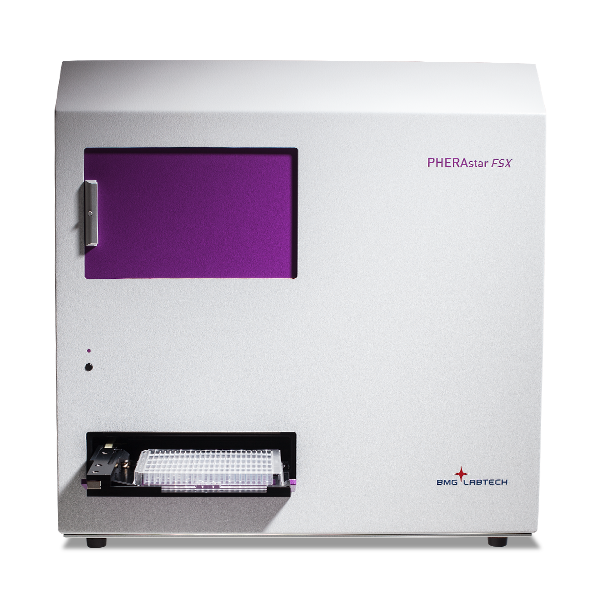
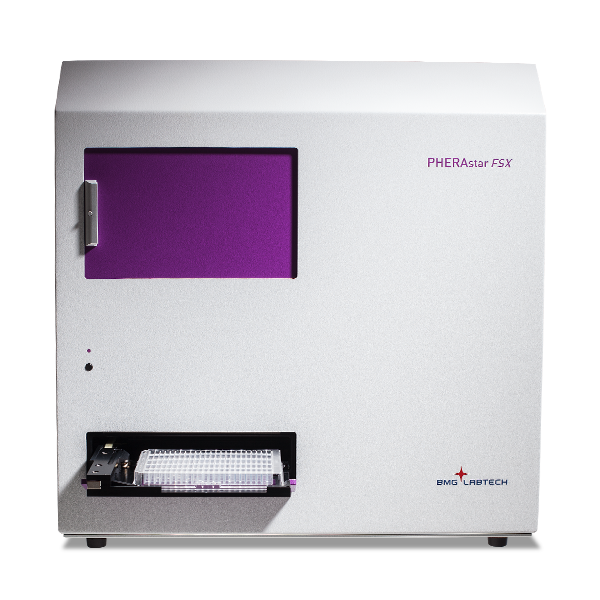
Microplate reader PHERAstar FSX

Technical specifications

Detection modes

Fluorescence intensity - incl. FRET
Fluorescence polarization
AlphaScreen®/AlphaLISA®/AlphaPlex™
Luminescence (flash and glow) - incl. BRET
Time-resolved fluorescence
TR-FRET
UV/Vis absorbance spectra

Measurement modes

Top and bottom reading
Endpoint and kinetic
Sequential multi-excitation
Sequential multi-emission
Simultaneous Dual Emission
Spectral scanning (absorbance)
Real-time ratiometric measurements
Well scanning

Microplate formats

Up to 3456-well plates, user-definable
LVis Plate with 16 low volume microspots (2 μL)

Microplate carrier

Robot compatible

Light sources

High energy xenon flash lamp
Dedicated laser for AlphaScreen®/AlphaLISA®/AlphaPlex™
Dedicated laser for TRF and TR-FRET

Detectors

Two matched pairs of photomultiplier tubes (PMTs), optimized for different detection modes
CCD spectrometer

Wavelength selection

Optic Modules: Up to six application-specific modules (includes all filters, dichroics, etc. for an application)
For top and bottom reading
UV/vis absorbance spectrometer: Full spectra or 8 distinct wavelengths in < 1 sec/well

Spectral range

Filters
230 - 750 nm or 230 - 900 nm for FI, FP
230 - 750 nm for LUM
230 - 900 nm for TRF

Spectrometer
220 - 1000 nm for ABS; wavelength precision: ≤ 0.5 nm

Sensitivity

FI
(top)
< 0.15 pM FITC (384sv black, 20 μL)
< 0.5 pM FITC (1536 black, 8 μL)

Dynamic Range: 8 decades


FI
(bottom)
<1.0 pM FITC (384g black, 50 μL)

FP
< 0.5 mP SD at 1 nM FITC (384sv black, 20 μL)
< 1.5 mP SD at 1 nM FITC (1536 black, 8 μL)

TRF with laser.
< 5 fM europium (384, 80 μL)
< 15 fM europium (1536, 8 μL)

HTRF®
(black and white microplates)
Reader Control Kit (Eu) after 18h (384sv, 20 μL)
Delta F > 1100% (High Calibrator)
Delta F > 25% (Low Calibrator)

LUM
< 0.4 pM (< 8 amol/well ATP, 384sv white, 20 μL)
Dynamic Range: 8 decades

AlphaScreen® with laser
< 5 pM (< 100 amol/well P-Tyr-100, 384sv white, 20 μL)

ABS with spectrometer
Selectable spectral resolution: 1, 2, 5, and 10 nm
OD range: 0 to 4 OD; photometric resolution: 0.001 OD
Accuracy: < 1% at 2 OD
Precision: < 0.5% at 1 OD and < 0.8% at 2 OD
Linearity: ≤ 0.8% at 2.0 OD


Read times

Flying mode (1 flash)
14 s (384)
27 s (1536)

10 flashes
38 s (384)
1 min 52 s (1536)

50 flashes
1 min 29 s (384)
5 min 18 s (1536)

Shaking

Linear, orbital, and double-orbital with user-definable time and speed

Incubation

+5 °C above ambient up to 45 °C

The upper heating plate of the incubation chamber operates at +0.5 °C more than the lower plate. This prevents condensation build-up on the lid or sealer

With Advanced Assay Stability (AAS) system: from 18 - 45°C

Software

Multi-user Reader Control and MARS Data Analysis Software included
FDA 21 CFR Part 11 compliant

Dimensions

Width: 45 cm, depth: 51 cm, height: 47 cm; weight: 49 kg

With AAS system: width: 48 cm, depth: 68 cm, height: 47 cm; weight: 62 kg

Optical path guides

Top and bottom: free-air optical light path guided by motor-driven mirrors and dichroics

Z'adjustment

Automatic focal height adjustment (0.1 mm resolution)

Reagent injection

Up to 2 built-in reagent injectors
Injection at measurement position (6 to 384-well)
Individual injection volumes for each well (3 to 500 µL, optionally up to 2 mL)
Variable injection speed up to 420 µL/s
Up to four injection events per well
Reagent back flushing

Integrated barcode reader

Up to three integrated barcode readers

Power requirements
  • 100 or 115 or 230 V, 50/60 Hz, auto ranging
Power consumption
  • Normal operating conditions: 50 W
  • Idle State: 20 W
  • AAS-option: + 30 W
  • Switched off: 0 W max. 300 VA
Optional Accessories
LVis plate

Sample Capacity: sixteen separate microdrop wells for 2 µL samples; one standard cuvette position for up to 1 mL samples

Quality Control Internal Standards (optional): four NIST traceable optical density filters (approximate values of 0.1, 0.3, 0.6 and 1.0 OD); one holmium oxide filter for wavelength accuracy

Dimensions: conforms to SBS standards for microplates

THERMOstar

Microplate incubator and shaker

Stacker

Magazines for up to 50 plates - continuous loading feature

Upgrades

Please contact your local representative for upgrades including options such as detection modes, reagent injectors, etc

*

LOD = 3 x SD (20 blanks) / slope (6 pt std curve)
AlphaScreen® P-Tyr-100 assay kit, PerkinElmer, #6760620C
384sv = 384-well small volume microplates
384g = 384-well glass bottom microplates
1536 = 1536-well microplates

The PHERAstar FSX is for research use only.

Trusted and loved by:customer-logos


Customer Reviews

nick-bland-300x300-kreis

Nick Bland, Group Leader at Domainex, Cambridge, UK


“We just ran HTS of several hundred thousand compounds using a TR-FRET assay on a PHERAstar with Z´ in the region of 0.9, every time an excellent confirmation of hits.”


Application Notes

See how scientists and researchers are using BMG Labtech’s PHERAstar FSX for HTRF measurements 

FAQs about HTRF using PHERAstar FSX

  • What maintenance requirements are associated with the PHERAstar FSX?

    BMG LABTECH microplate readers are built to be robust and reliable. No calibration of optical components is required. Recommended maintenance includes plate carrier offset adjustments, cleaning optical components, software/firmware updates, and routine performance checks.
  • What are the maintenance costs and plans?

    BMG LABTECH offers flexible maintenance plans to ensure long-term performance. Costs depend on the chosen plan. Contact us using the service contract form.
  • Does BMG LABTECH offer technical support or training for the PHERAstar FSX?

    Yes, comprehensive technical support and training services are available to assist users in maximizing the instrument’s capabilities. Contact us to find out more.
  • Where can I find additional information or purchase options for the PHERAstar FSX?

    You can find detailed product information, specifications, and available configurations on the PHERAstar FSX product page.  For purchase options, quotes, or personalized recommendations, please send a sales request directly. 
  • How can I request additional Optic Modules?

    You can request a quote for additional Optic Modules via our filter request form.
  • Where can I find manuals for my PHERAstar FSX?

    Reader manuals are included with every instrument. If you no longer have your manual, please use our manual request form to obtain a copy.
  • Where can I find the software for my PHERAstar FSX?

    The software is included with every reader and can be installed on as many computers as needed. You can find it on a USB stick (or CD for older models) included with the manual. If you’ve misplaced the USB stick or CD, we can provide a download link. Contact our software support.
  • Is the BMG LABTECH software for my PHERAstar FSX compatible with Windows 11?

    Yes, the software for your PHERAstar FSX is fully compatible with Windows 11. To ensure smooth operation on Windows 11, or if you need help with installation or have compatibility questions, please contact our software support.
  • What are the acquisition costs for a PHERAstar FSX?

    Costs vary depending on the chosen configuration. Contact us for a personalized quote.
  • Are there tutorials on how to optimise my microplate reader measurements?

    Yes, we provide comprehensive How-To Notes that explain common detection parameters, how they influence your results, and practical tips for optimizing measurements. You can find these resources on our How-To notes page.
  • What is the typical delivery time?

    Delivery times depend on model availability, configuration and your location. For accurate lead times, please send a general request on the contact page directly. 
Newsletter Sign-up