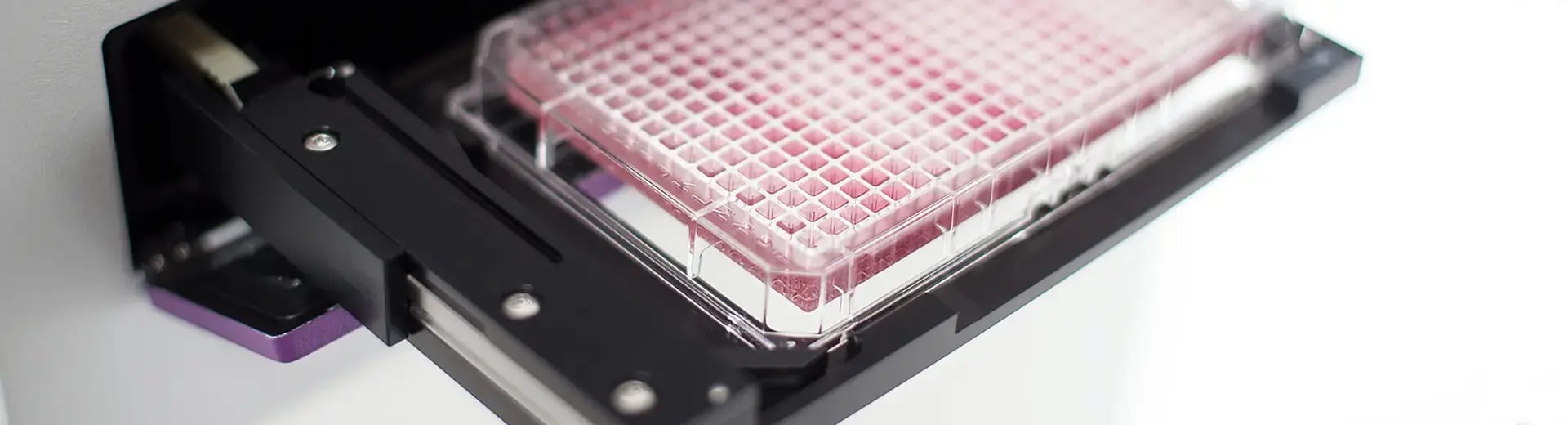







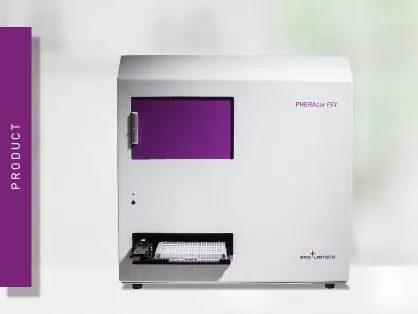
A microplate spectrophotometer measures the absorbance of liquid samples held in a microplate by quantifying how much light at a specific wavelength passes through each well. Unlike fluorescence or luminescence, absorbance is an absolute measurement expressed in Optical Density (OD) - the logarithmic ratio of incident to transmitted light intensity. Transmission (the proportion of photons passing through the sample) can also be reported.
- Initial recommendation
- Detailed Recommendation
Get help selecting the right microplate reader
Configure your microplate reader and get an initial recommendation!

Optically, the instrument comprises a high-intensity light source, wavelength selection optics, a sample compartment, and a reference channel. The detector sits on the opposite side of the plate from the light source and records how much light is transmitted at each wavelength; photons that do not reach the detector have been absorbed by the sample. The Beer-Lambert law links the measured absorbance to analyte concentration, enabling direct quantification of nucleic acids, proteins, and small molecules. Standard curves can be used where direct calculation is not possible.
Compared with traditional single-cuvette spectrophotometers, microplate spectrophotometers dramatically increase throughput: standard instruments read 96-well plates, while high-end models support 384- and 1536-well formats. They are used across academic life science, drug discovery, clinical laboratories, synthetic biology, and food and water quality monitoring.
Plate spectrophotometers are available as dedicated single-mode instruments or as part of multi-mode readers that combine UV/vis absorbance with fluorescence and luminescence detection.
Do you want to use a microplate spectrophotometer in your lab?
Request a quote or ask for more information here:
Choosing the right plate spectrophotometer affects the quality of your data. Whether you need a dedicated UV/vis absorbance instrument or a multi-mode platform with fluorescence and luminescence, the key considerations below will help you identify the best fit for your applications.
Wavelength selection
Wavelength selection is determined by detector type. Two approaches are common:
-
PMT-based instruments use optical filters or a monochromator to select specific wavelengths before the light reaches the sample. For spectral scanning, a monochromator steps through wavelengths mechanically - measuring each sequentially - which adds time.
-
CCD spectrometer-based instruments acquire the full wavelength range simultaneously in a single flash, with no mechanical movement. This makes spectral acquisition significantly faster.
All BMG LABTECH UV/-vis microplate spectrophotometers use a CCD-based UV/vis spectrometer, capturing a full spectrum from 220 to 1000 nm in under one second per well.
Compatible microplate formats
Most routine absorbance assays - including ELISA and protein quantification - are run in standard 96-well plates. For higher throughput or smaller sample volumes (10–50 µL), 384- and 1536-well formats offer significant reagent savings. Confirm that your chosen plate spectrophotometer supports the format you need before purchasing.
Shaking and incubation
Incubation at controlled temperatures (e.g., 37°C) is essential for enzymatic assays and cell-based measurements. Plate shaking ensures proper mixing and, for microbial growth assays (OD600), provides the oxygenation needed for consistent cell replication. Check that your plate spectrophotometer offers the incubation range and shaking modes your applications require.
Compatibility with cuvettes
Traditional cuvette-based spectrophotometry uses a fixed 1 cm pathlength. In microplates, pathlength varies with well volume and format, but can be normalised using water-peak path length correction for aqueous samples.
If your workflow still requires occasional cuvette measurements, look for a plate spectrophotometer with an integrated cuvette port or a horizontal cuvette adapter such as the LVis Plate.
Data analysis software
Microplate reader software is often overlooked but plays a crucial role in performance; some programs merely control measurements and output raw data, while others handle advanced data analysis.
Intuitive, flexible software simplifies both detection and analysis, helping you get the most from your instrument. Essential features include automatic blank subtraction, concentration calculations based on standard curves or the Beer–Lambert law, 260/280 ratio determination, path length correction, and enzymatic constant calculations (Km and Vmax).
BMG LABTECH’s software includes predefined quick-run protocols and dedicated analysis templates for common assays. These tools allow data acquisition and analysis with a single click - streamlining workflows and speeding up experimental results.
![]()
Our microplate spectrophotometers
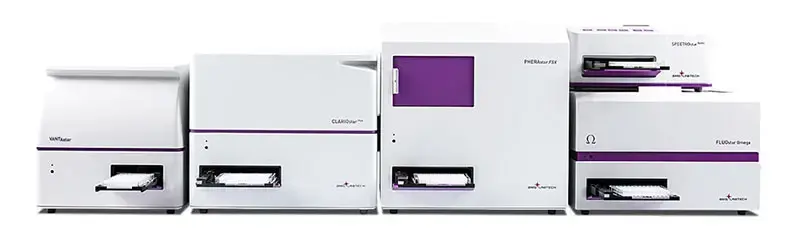
BMG LABTECH offers a range of plate spectrophotometers - from dedicated single-mode instruments to high-throughput multi-mode platforms. All are equipped with a high-intensity xenon flash lamp and CCD-based UV/vis spectrometer, capturing a full spectrum from 220 to 1000 nm (resolution 1–10 nm) in under one second per well. BMG LABTECH was the first manufacturer to use a UV/vis spectrometer for microplate absorbance measurements.
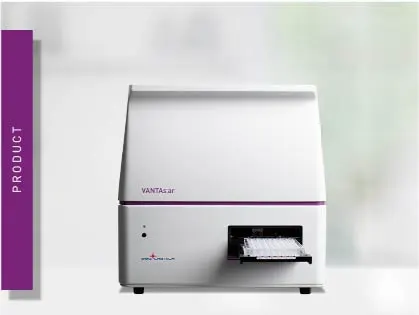
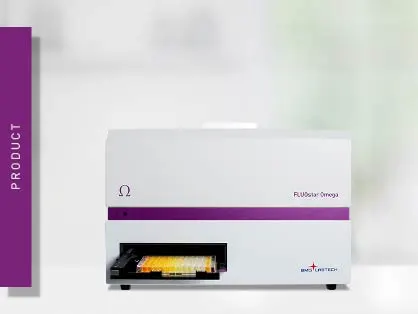
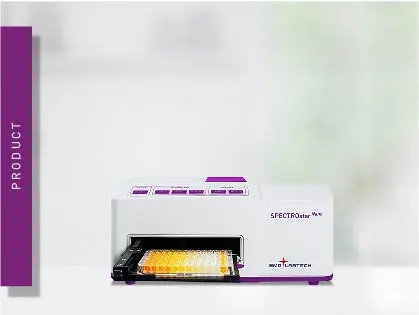
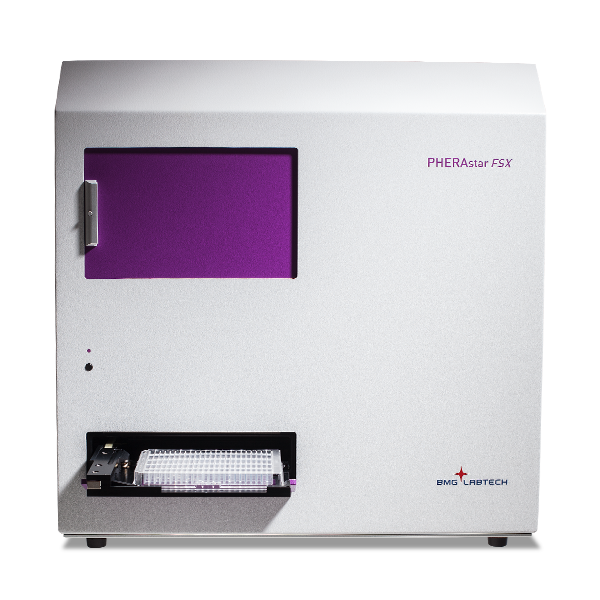
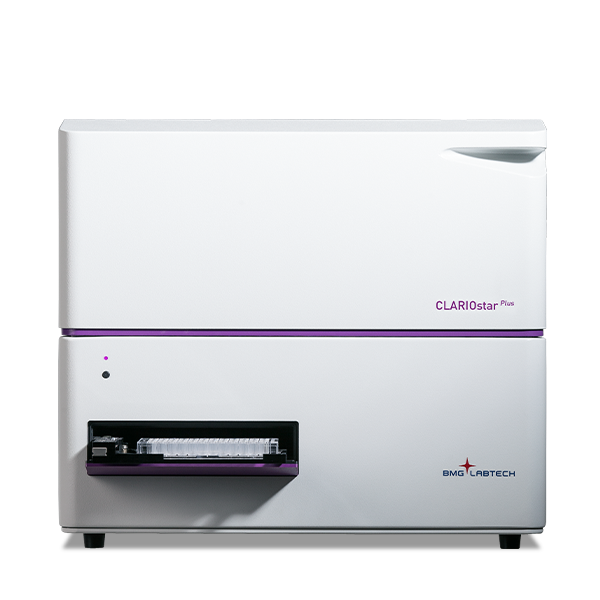
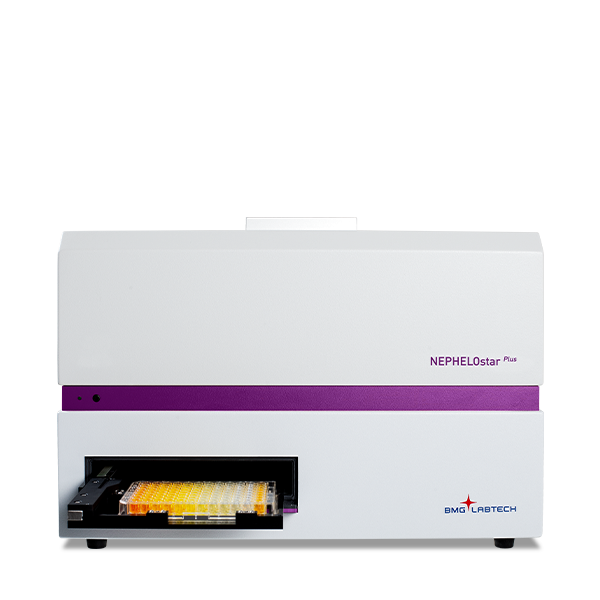
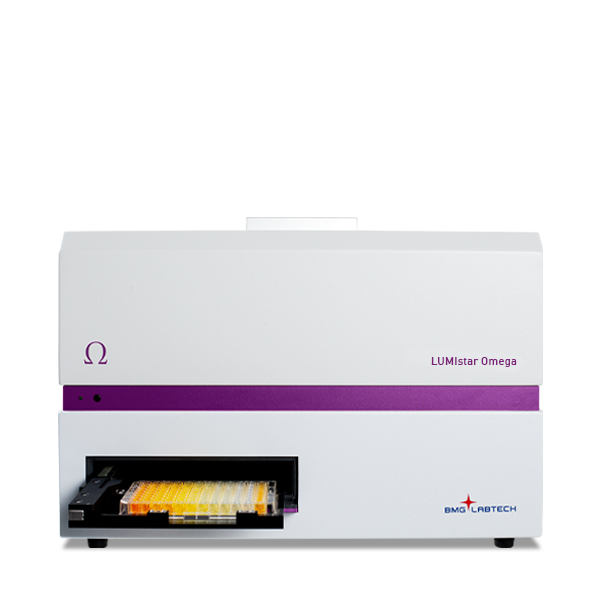
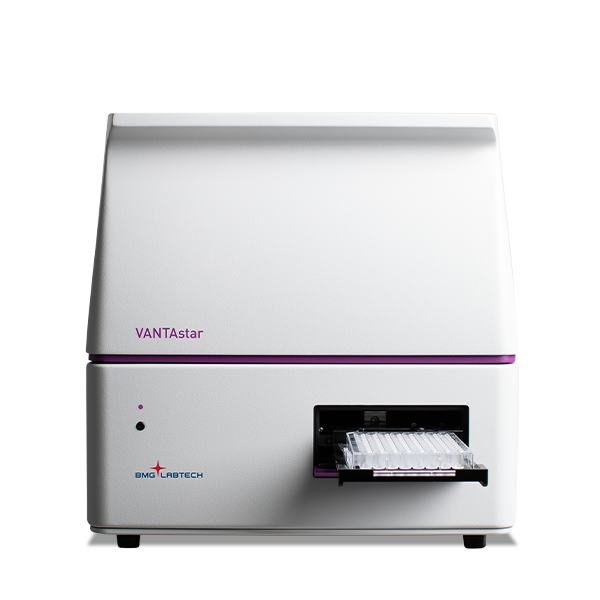
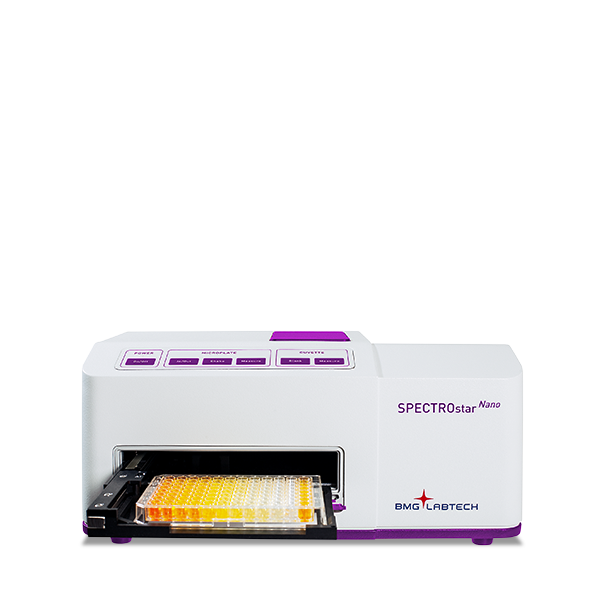
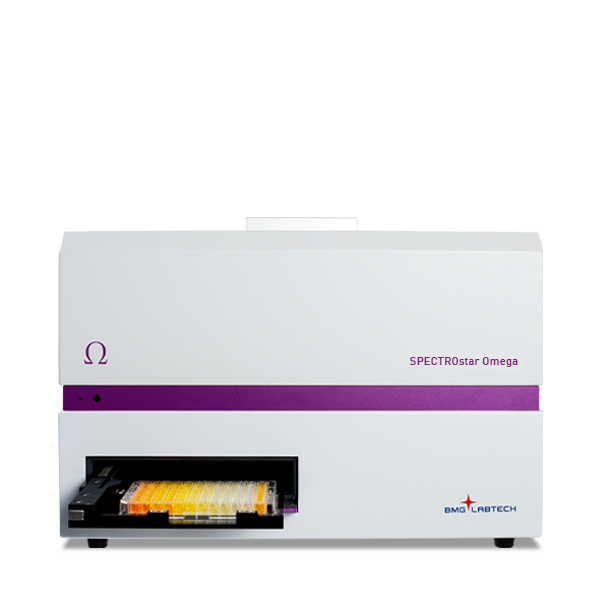
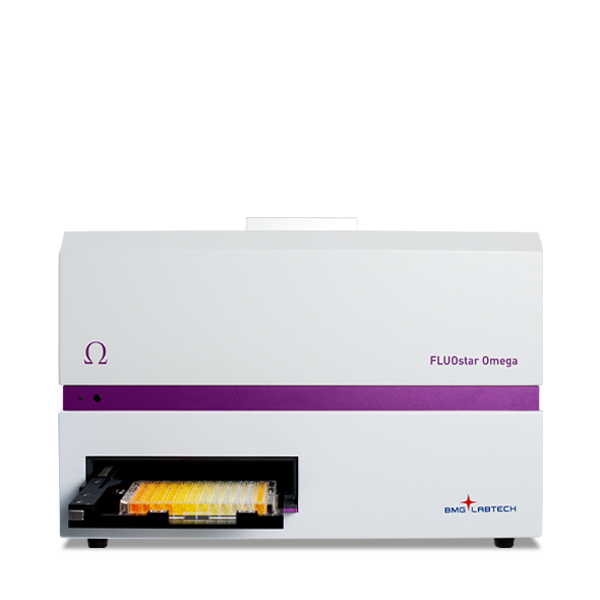
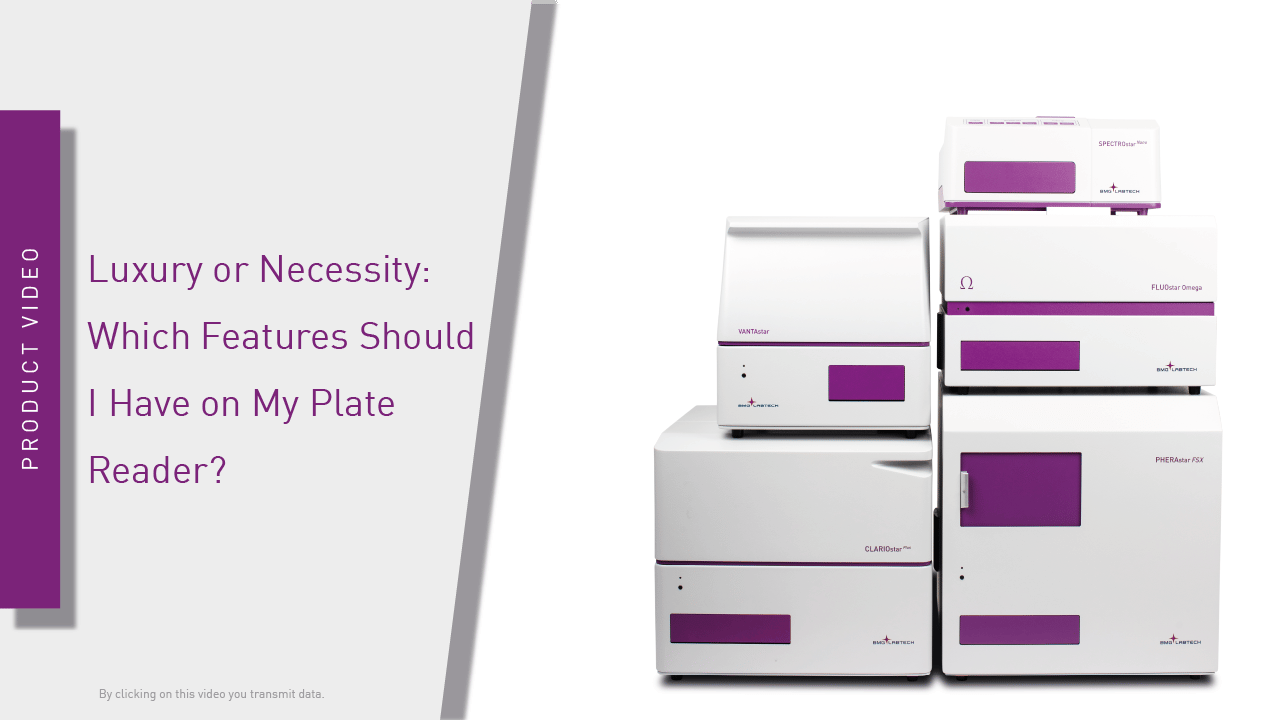
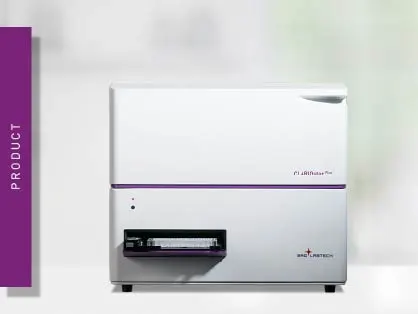
The PHERAstar FSX, CLARIOstar Plus, VANTAstar, and SPECTROstar Omega combine UV/vis absorbance with additional detection modes. The SPECTROstar Nano is our dedicated absorbance-only plate spectrophotometer. Filter-based (PMT) absorbance detection is also available on the FLUOstar Omega.

CLARIOstar Plus
VANTAstar
Omega Series
SPECTROstar Nano
Trusted and loved by:
Which assays can be measured by a plate spectrophotometer?
Absorbance is one of the most widely used detection modes in life science research, with a large ecosystem of commercial kits and reagents designed for microplate formats. Common applications include:
-
Nucleic acid quantification (DNA/RNA at 260 nm; purity assessed by 260/280 and 260/230 ratios)
-
Protein quantification — ELISA, Bradford, BCA, Lowry
-
Microbial and cell growth monitoring (OD600 in bacteria and yeast)
-
Cell viability assays (MTT, MTS, and other colorimetric methods)
-
Enzyme kinetics - monitoring changes in absorbance over time to determine reaction rates, Km, and Vmax
-
General colorimetric assays adapted to 96-, 384-, and 1536-well plate formats
Examples of measurements with BMG LABTECH absorbance microplate readers:
The following are examples of absorbance measurements taken on BMG LABTECH microplate readers:

- AN 362: DNA purity ratio – fast and easy absorbance-based evaluation of nucleic acid quality
- AN 341: Highly sensitive ELISAs in 90 minutes: SimpleStep ELISA kits and the SPECTROstar Nano
- AN 299: Absorbance-based methods for protein quantification on BMG LABTECH instrumentsAN 303: Detection of plant-synthesized nanoparticles and their antibacterial capacity
Why to choose a BMG LABTECH absorbance plate reader?
BMG LABTECH is specialised in producing microplate readers only and brings more than 30 years of full expertise in microplate reading technology. This knowledge gets visible in the results that our instruments deliver - the only factor that counts in your lab! Our users can trust to obtain excellent performance in sensitivity, speed and flexibility. Moreover, our single and multi-mode readers are developed to provide optimum performance for years. Our instruments are developed, produced and tested in Germany and are built to be extremely robust and reliable.
Buy only what you need
Due to their modularity, all our multimode plate readers can be equipped with different detection modes and cover a multitude of applications. Additional features can be upgraded. This gives you the chance to keep your options open even if you don’t use the full scope of your microplate reader right at the bat.
All-round service and support
We strive to provide you with the very best customer service and support. If you need customer support, we are only a phone call or email away. During business hours, you immediately speak live to a person who is happy to assist. There is no automated phone system or waiting in a queue. Our scientists, engineers and technicians are always there to help.
Multi-user software package
All our instruments come with a multi-user software package that can be installed on as many computers as users require, without the need to purchase licenses. Software updates for our microplate readers are of no charge within the first 12 months after purchase.
Frequently asked questions
-
What is a microplate spectrophotometer?
A microplate spectrophotometer measures UV/vis absorbance across all wells of a microplate, quantifying how much light is absorbed at specific wavelengths. Results are expressed in Optical Density (OD) units and used to calculate analyte concentration via the Beer-Lambert law or a standard curve. Common formats include 96-, 384-, and 1536-well plates. -
What are the key features of a spectrophotometer?
Key features to evaluate include: detector type (CCD vs PMT), wavelength range and resolution, supported plate formats (96, 384, 1536-well), read speed, shaking and incubation options, cuvette compatibility, and the depth of the bundled data analysis software. -
What is the difference between a plate reader and a spectrophotometer?
A traditional spectrophotometer measures one sample at a time in a cuvette. A plate spectrophotometer applies the same absorbance measurement principle to a microplate, allowing 96 to 1536 samples to be measured in a single run - increasing throughput and reducing reagent volumes significantly. -
Which applications can benefit from using a spectrophotometer?
It is ideal for microplate-based applications such as colorimetric assays, enzymatic assays, ELISA, nucleic acid quantification, protein assays, cell-based assays with appropriate reagents, and kinetic/endpoint measurements. -
What is a 96 well plate spectrophotometer?
A 96 well plate spectrophotometer reads absorbance from all 96 wells of a standard microplate in a single measurement run. It is the most common format for routine assays including ELISA, Bradford protein quantification, and OD600 bacterial growth monitoring. -
Are microplate spectrophotometers compatible with different types of microplates?
Common formats include 6-, 12-, 24-, 48-, 96-, and 384-well plates. Some models also support 1536- or even 3456-well plates. -
Can spectrophotometers be integrated into existing laboratory systems?
Not all spectrophotometers have compatibility with automation systems for high-throughput screening and seamless integration into laboratory automation setups. BMG LABTECH's spectrophotometers are fully compatible with modern laboratory automation systems.