





Basic information about HTRF microplate readers
What is a HTRF microplate reader?
An HTRF microplate reader is a laboratory instrument designed to detect and quantify TR-FRET signals in microplate format. HTRF-certified readers are validated by Revvity (formerly Cisbio) to ensure reliable performance with HTRF reagents and kits.
These instruments support all TR-FRET-based technologies including LANCE, Transcreener® and THUNDER™, and are compatible with 96, 384 and 1536-well microplate formats for both standard and high-throughput applications.
For a full explanation of the HTRF detection principle, donor/acceptor pairs and assay technology, visit our HTRF technology guide.
Do you want to use an HTRF plate reader in your lab?
Request a quote or more information here:
- Initial recommendation
- Detailed Recommendation
Get help selecting the right microplate reader
Configure your microplate reader and get an initial recommendation!
If you are on the market for a new HTRF-compatible reader, there are a few factors to take into account, as the performance of the instrument can significantly affect the quality of your research results.
Sensitivity
For quantification purposes, HTRF assays generally offer greater sensitivity than fluorescence ones. Nevertheless, a HTRF microplate reader with better sensitivity will deliver data with a better statistic, less variability among replicates, and a larger delta (distance) between responding and not-responding samples. In addition, a better sensitivity will allow you to reduce the amount of reagents and/or samples used to achieve good quality results and consequently reduce costs.
Excitation and wavelength selection
As the cryptate complex is typically excited at 337 nm, a xenon flash lamp or a specific excitation laser can be used as a light source. A TRF laser focuses more energy at 337 nm and leads to better results with better discrimination between low and high signals.
The TRF laser on the PHERAstar FSX operates at 60 Hz, enabling measurement of a full 1536-well plate in as little as 36 seconds while maintaining Z’ > 0.8 - making it the fastest HTRF microplate reader available for high-throughput screening.
Wavelength selection in time-resolved fluorescence microplate readers is mandatory both for excitation and emission. This helps to separate the emission signals of the acceptor and the donor. Filter-based instruments are usually recommended as they are more sensitive than monochromator-based ones. Additionally, the capability of detecting two emission channels simultaneously is quite beneficial for ratiometric assays. This option halves measurement time and reduces data variability. Simultaneous Dual Emission (SDE) detection is available on the PHERAstar FSX.
Compatible microplate formats
Commonly in life science research, basic fluorescence assays are measured in 96 well microplates. However, if you have multiple samples and/or wish to save precious reagents or time, 384 well and 1536 well formats can also be used. Just make sure that your fluorescence microplate reader of choice is also capable of reading the microplate format you plan on using. Moreover, absorbance, fluorescence, and luminescence detection require different plate types.
Reagent injectors
When looking for a microplate reader, you should consider the nature of the assay you want to run. For binding assays and binding kinetics, the use of injectors can be beneficial. By manually pipetting reagents into the wells, you can run the risk of losing important data of your reaction. Especially for fast responses, the event you are looking for may already be gone before you detect it. Our readers equipped with reagent injectors can simultaneously inject and detect the signal of a well, and then move to the next one.
Software for data reduction
Generally, the software that runs the microplate reader is a very underestimated part of the package. For some readers, the software only controls the measurement process and provides a raw assay data output. In other cases, it can perform complex analyses.
A comprehensive, easy-to-use and flexible software can make life easier, simplify detection and data analysis so that you can get the most out of your instrument. The most useful calculation features for TR-FRET assays include ratiometric calculations, automatic calculation of concentrations based on standard curves, and enzymatic constants such as Km and Vmax.
On the BMG LABTECH software package, the most common assays have predefined quick-run assay-specific protocols and dedicated analysis templates. Through these dedicated solutions, acquisition and analysis of your results are performed with a single mouse click, enabling researchers to carry out experiments quickly and easily.
Dedicated HTRF protocol templates and one-click analysis tools are pre-installed, enabling researchers to run and analyse HTRF assays without manual configuration.
![]()
HTRF-Certified Microplate Readers
HTRF certification is awarded by Revvity (formerly Cisbio) to microplate readers that meet validated performance standards for HTRF assay detection. Certification ensures that results obtained on the reader are consistent with Revvity’s published assay specifications.
The PHERAstar FSX is HTRF-certified for both white and black microplates, and validated for 96, 384 and 1536-well formats. Certification covers:
-
Excitation at 337 nm with dedicated TRF laser or xenon lamp
-
Simultaneous detection of donor (620 nm) and acceptor (665 nm) emission channels
- Z’ ≥ 0.5 across standard HTRF assay formats
-
Compatibility with all Revvity HTRF reagent kits
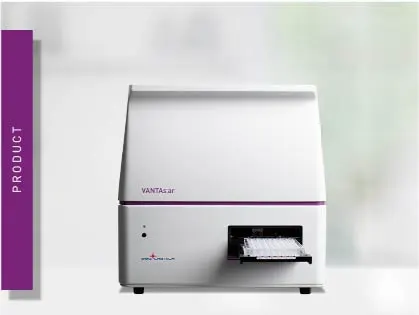
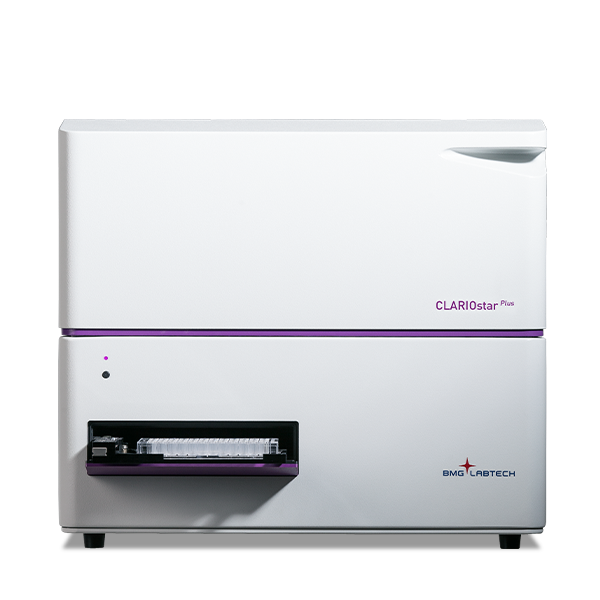
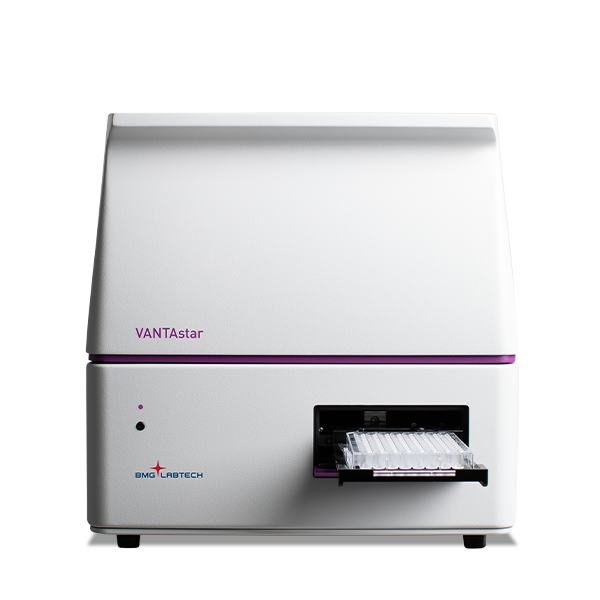
The CLARIOstar Plus and VANTAstar also support HTRF measurements with filter-based TR-FRET detection, offering flexibility for assay development and lower-throughput workflows.
![]()
Our HTRF microplate readers
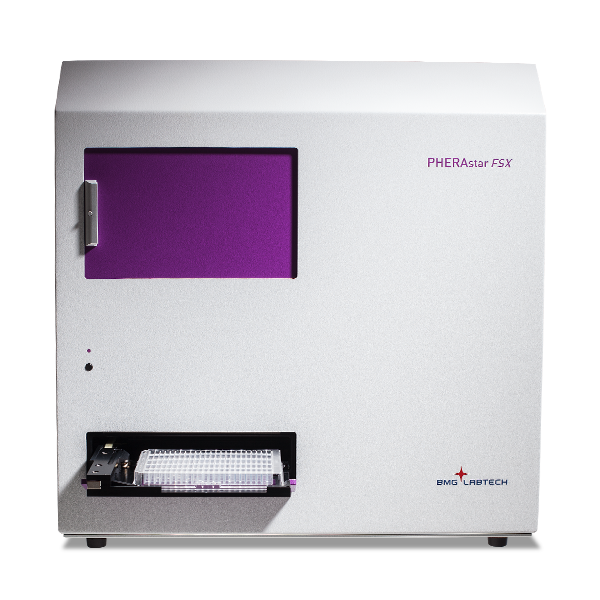
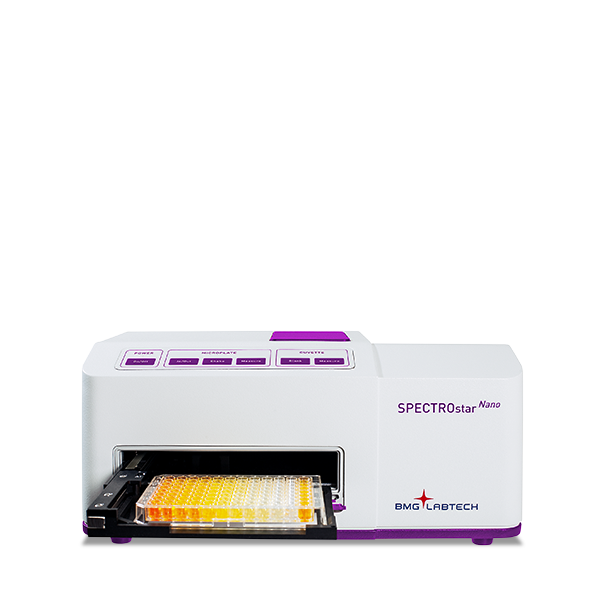
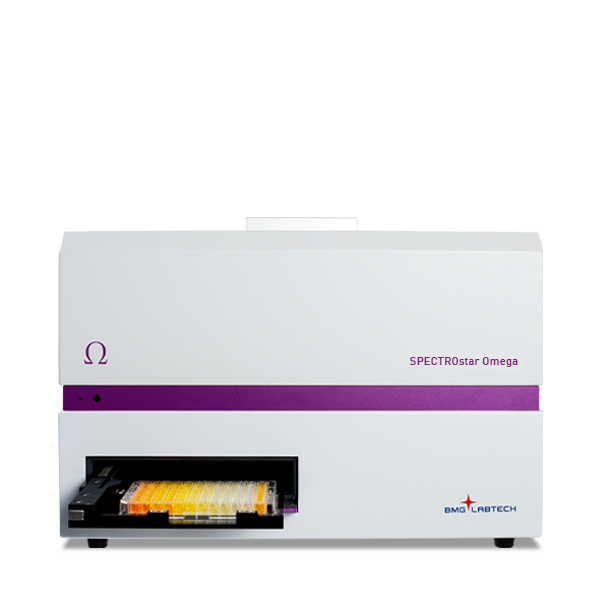
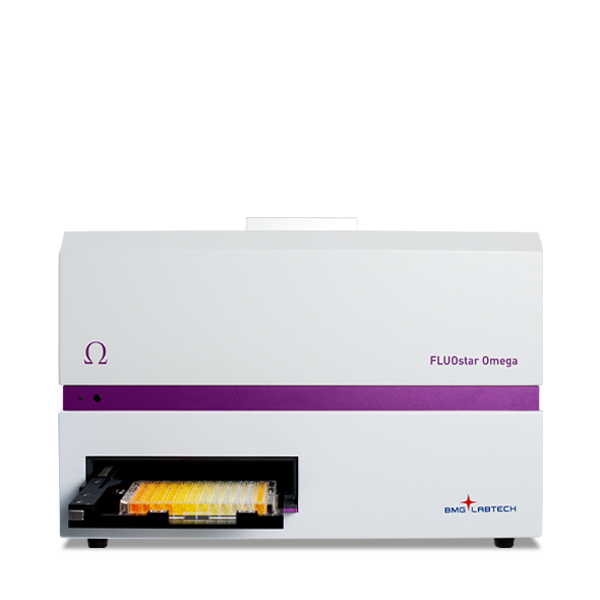
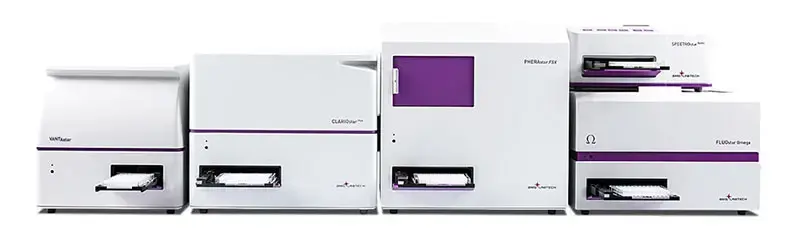
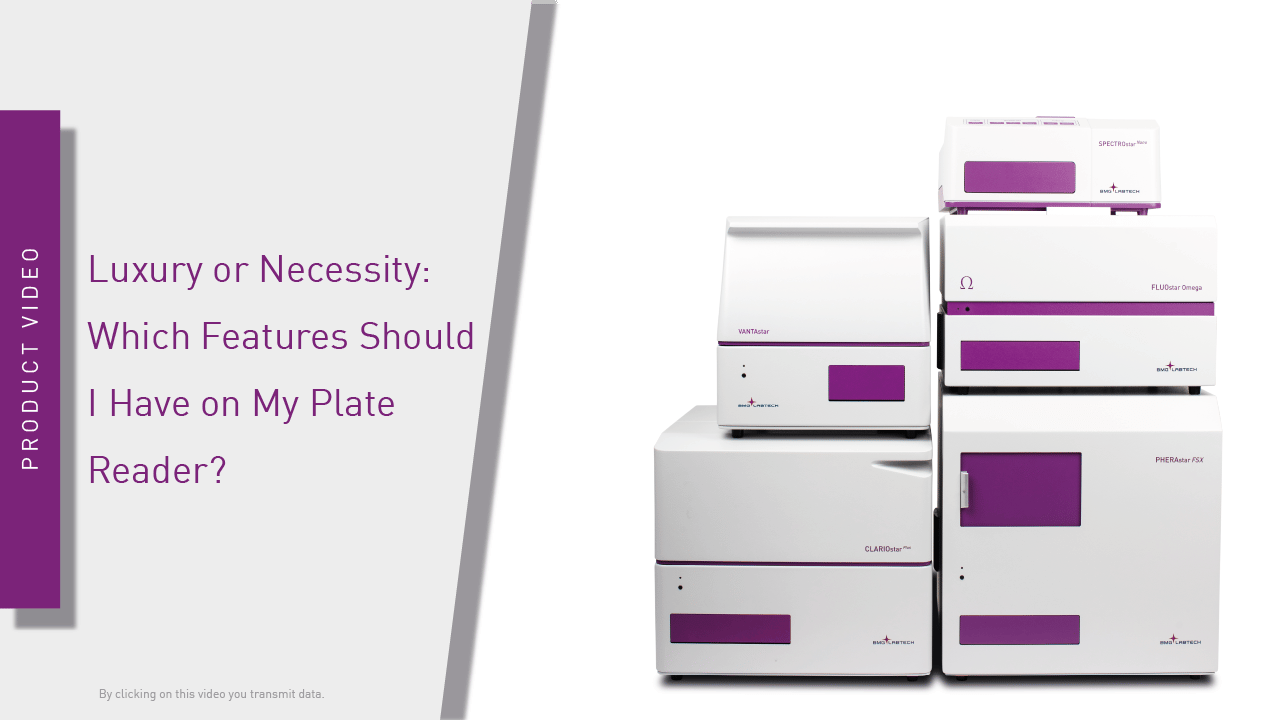
All TR-FRET-based assays can be detected on the PHERAstar® FSX, CLARIOstar® Plus, and VANTAstar®.
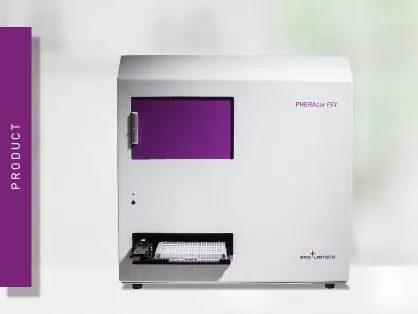
The PHERAstar FSX is the best microplate reader for all HTRF assays:

- Sensitive, fast and reliable measurements with best Z´ and DeltaF%
- HTRF-certified with white and black plates
- Dedicated excitation laser and detectors (PMTs) for best sensitivity
- Simultaneous detection of donor and acceptor gives speed and precision
- Plate formats up to 3456 wells for assay miniaturization
- Best microplate reader for HTRF-based kinetic binding assays
CLARIOstar Plus
VANTAstar
Simultaneous Dual Emission (SDE) for HTRF
Standard HTRF microplate readers measure the donor and acceptor emission channels sequentially - one after the other. The PHERAstar FSX uses Simultaneous Dual Emission (SDE) detection, measuring both channels at the same time with two matched photomultiplier tubes (PMTs).
SDE offers three key advantages over sequential detection:
-
Speed: plate read time is halved compared with sequential measurement
-
Precision: both channels are captured from the same excitation flash, eliminating any inter-flash variability
-
Reduced %CV: lower coefficient of variation across replicates, improving assay quality and Z’ values
SDE is particularly valuable in high-throughput HTRF screening where read time and data consistency directly affect screening output.
Decay Curve Monitoring for HTRF Assay Development
Unlike standard microplate readers that integrate TRF emission over a fixed time window, the PHERAstar FSX uses photon-counting detection to capture the full lanthanide decay curve at 2 μs time resolution.
This unique feature - Decay Curve Monitoring - allows researchers to:
-
Visualise the complete emission decay profile of europium and terbium donors
-
Optimise integration start and stop times for each specific assay
-
Identify and eliminate sources of background interference
-
Accelerate HTRF assay development and troubleshooting
Combined with the Integration Wizard, Decay Curve Monitoring reduces assay development time and ensures optimal TR-FRET detection parameters are applied before moving to full-scale screening.
Trusted and loved by:
HTRF measurements and applications
BMG LABTECH HTRF microplate readers support the full range of HTRF assay types across 96, 384 and 1536-well formats:
-
Protein-protein and ligand-receptor binding assays
-
GPCR functional assays (cAMP, IP-One) and receptor oligomerisation studies
-
Kinase and phosphorylation assays
-
Cytokine and biomarker quantification
-
Cell-based assays including cell lysate measurements in culture medium
-
Assay miniaturisation from 384 to 1536 and 3456-well formats
For detailed HTRF application examples and assay protocols, see our HTRF application notes below.

Why to choose a BMG LABTECH HTRF device?
BMG LABTECH is specialised in producing microplate readers only and brings more than 30 years of full expertise in plate reading technology. This knowledge gets visible in the results that our instruments deliver - the only factor that counts in your lab! BMG LABTECH users can trust to obtain best results in sensitivity, speed and flexibility. Moreover, our multi-mode microplate readers are developed to provide optimum performance for years. Our instruments are developed, produced and tested in Germany and are built to be extremely robust and reliable.
Buy only what you need
Due to their modularity, all our fluorescence plate readers can be equipped with different detection modes and cover a multitude of applications. Additional features can be upgraded at any time. This gives you the chance to keep your options open even if you don’t use the full scope of your microplate reader right at the bat.
All-round service and support
We strive to provide you with the very best customer service. All sales area representatives are highly trained technical specialists able to support both the hardware, software and most application questions. For the most complex applications solutions a team of dedicated application specialists are also available.
Multi-user software package
All our instruments come with a multi-user software package that can be installed on as many computers as users requires, without the need to purchase licenses. Software updates for our microplate readers are of no charge within the first 12 month after purchase.
Frequently asked questions
-
Which BMG LABTECH readers are HTRF-certified?
The PHERAstar FSX is BMG LABTECH’s primary HTRF-certified microplate reader, validated for both white and black plates in 96, 384 and 1536-well formats. The CLARIOstar Plus and VANTAstar also support HTRF and TR-FRET detection with flexible filter-based configurations. -
What is the difference between the PHERAstar FSX and CLARIOstar Plus for HTRF?
The PHERAstar FSX is optimised for high-throughput HTRF screening: it features a dedicated TRF laser, Simultaneous Dual Emission (SDE) for speed and precision, and supports plates up to 3456 wells. The CLARIOstar Plus offers greater assay flexibility, making it well better suited for HTRF assay development and multi-mode workflows. -
How fast can the PHERAstar FSX read a 1536-well HTRF plate?
With TRF laser excitation at 60 Hz and Simultaneous Dual Emission detection, the PHERAstar FSX can measure a complete 1536-well plate in approximately 36 seconds, while maintaining Z’ values above 0.8. -
What is the BMG LABTECH HTRF microplate reader and what are its primary applications?
The BMG LABTECH HTRF microplate reader is a laboratory instrument designed for the detection of Homogeneous Time-Resolved Fluorescence (HTRF) signals. It is primarily used in drug discovery and biomolecular research to measure molecular interactions with high sensitivity and precision. -
What are the key features of the BMG LABTECH HTRF Microplate Reader?
Key features include advanced optical detection technology, Simultaneous Dual Emission, dedicated laser excitation, Decay Curve Monitoring, compatibility with various microplate formats, customizable excitation and emission filters, robust data analysis software, and high sensitivity. -
Is the BMG LABTECH HTRF microplate reader compatible with different assay types?
Yes, it supports a wide range of assays including protein-protein interactions, enzyme activity assays, receptor binding studies, signaling pathway readouts, and other biomolecular interactions that utilize HTRF or similar TR-FRET-based techniques. -
What plate types are compatible with HTRF readers?
96- and 384-well plates are common. High-throughput screening readers like the PHERAstar FSX support 1536 and even 3456-well plates. -
Can the BMG LABTECH HTRF microplate reader be integrated into automated workflows?
Yes, it is designed for seamless integration into automated laboratory systems, enabling high-throughput screening processes and reducing manual handling errors. -
What kind of data analysis capabilities does the software provide?
The accompanying software offers comprehensive data analysis tools including curve fitting, statistical analysis, enzyme & binding kinetics, etc. -
What maintenance requirements are associated with this microplate reader?
BMG LABTECH microplate readers are built to be robust and reliable. No calibration of optical components or light source is required. Recommended maintenance includes plate carrier offset adjustments, cleaning optical components, software/firmware updates, and routine performance checks. -
Is technical support available for users of the BMG LABTECH HTRF microplate eader?
Yes, BMG LABTECH provides technical support through training programs, user manuals, troubleshooting assistance, and direct customer service channels to ensure proper operation and maintenance. -
Where can I find additional resources or purchasing options for this microplate reader?
Additional information can be obtained from the official BMG LABTECH website or authorized distributors. They offer product specifications, purchasing options, application notes, and technical support contacts.