







Introduction
Estrogenic endocrine-disrupting chemicals (eEDCs) are a significant public health concern due to their ability to mimic or interfere with the function of the Estrogen Receptor (ER). The binding of a ligand to the ER triggers a critical step: receptor dimerisation, where the ER can form three distinct functional subtypes: two homodimers (ERα/α, ERβ/β) and a heterodimer (ERα/β). ERα homodimers are known to drive breast cancer growth, while ERβ homodimers exhibit anti-proliferative effects1. The heterodimers, consisting of both ERα and ERβ, provide a unique balance in regulating gene expression and cellular functions2. Current regulatory guidelines (e.g., OECD Test Guidelines) comprehensively cover ligand binding and transcriptional activation but do not include an assay to assess ER dimerisation, leaving a crucial gap in eEDC hazard evaluation.
To address this, a unified platform of highly sensitive ER Dimerisation-Detecting Biosensors (ERDDBs) based on Bioluminescence Resonance Energy Transfer (BRET) was developed3. This system enables rapid, real-time assessment and subtype-specific classification of eEDCs, providing necessary mechanistic data for risk assessment.
Assay principle
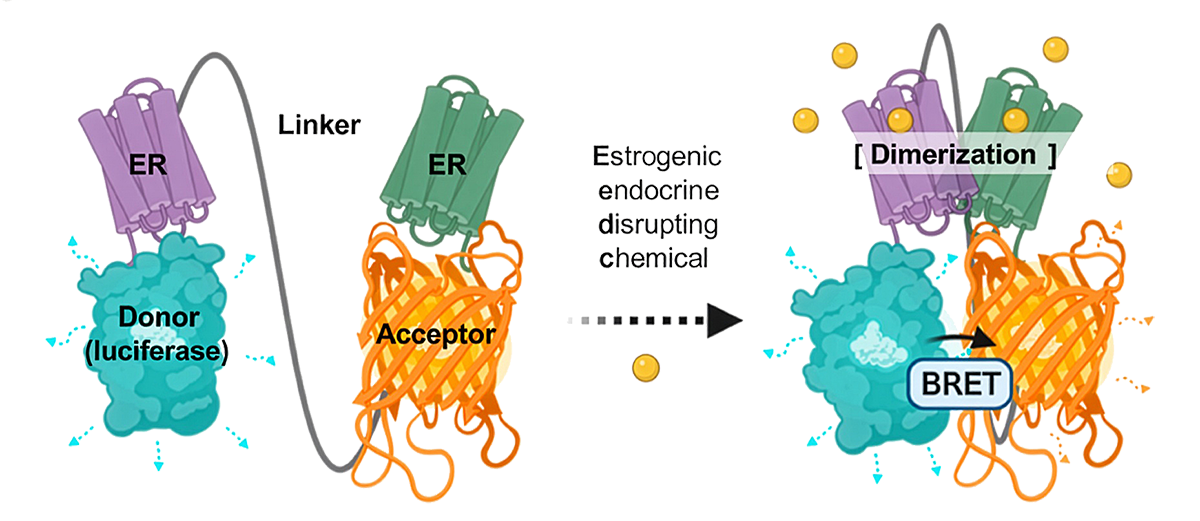
The ERDDB platform is engineered to detect the physical interaction (dimerisation) of two ER monomers in live cells. Each ER monomer is tagged with a BRET component: the donor (Nano-Luciferase) is fused to one monomer, and the acceptor (HaloTag 618) is fused to the other. Upon binding of estradiol (E2) or eEDC, the receptor dimerizes, bringing the donor and acceptor within 10 nm of each other, resulting in an efficient BRET energy transfer and increased BRET ratio (figure 1).
Materials & methods
- white flat-bottom 96-well half-area plate #675083, Greiner Bio-One)
- CLARIOstar Plus (BMG LABTECH)
- 17β-estradiol (E2) (#S1709, Selleck Chem)
- 72 estrogen analogs or EAs (MFDS, Rep. of Korea)
- HaloTag® NanoBRET® 618 Ligand, NanoBRET Nano-Glo® Substrate, Nano-Glo Endurazine Substrate
(#G980A, #N157A, #N257B) Promega - α/α, α/β and β/β ERDDB stable cell lines (according to 3)
- assay media (according to 3)
- chemicals and drugs from various manufacturers
(according to 3)
eEDCs screening
For the eEDCs screening assay, the assay media consisted of clear DMEM (GenDEPOT, CM004-310) supplemented with 0.5% FBS, 1% of 100 U/ml penicillin, and 100 μg/ml streptomycin. Stable cells were cultured in 75T flasks (SPL, 70075) and harvested prior to the assay. The cells were resuspended in assay media, and 50,000 cells were added to a white solid-bottom 96-well half-area plate and incubated overnight. The endurazine substrate (final dilution 1:100) was injected into the wells 2 h before the measurement. After 2 h, luminescence was measured to obtained data before treatment, and then the wells were treated with estrogen hormone E2 and various EAs at 1 μM final concentration. Plates were measured at 6, 12, and 24 h after treatment.
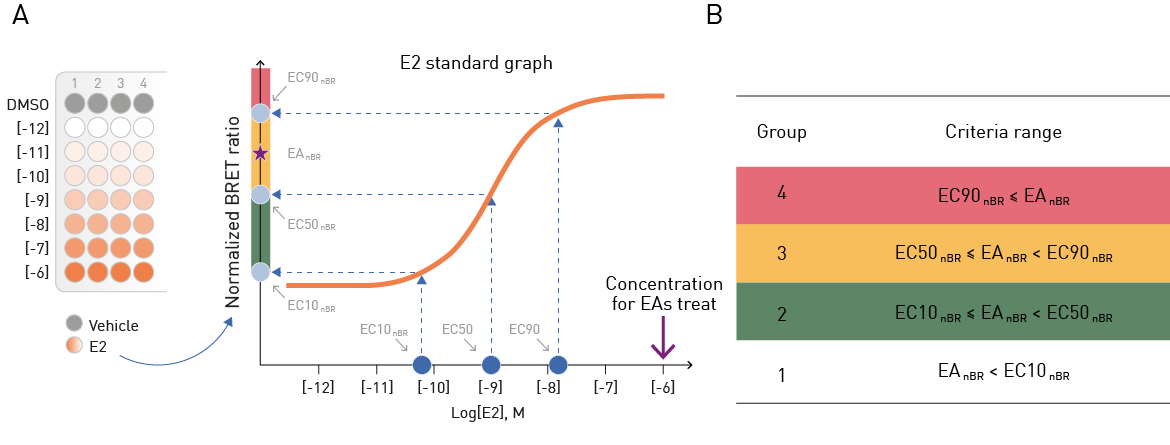
The sigmoidal dose-response curves and logEC values were generated by plotting log(agonist) values against the response-variable slope3. The BRET ratio and nBRs were calculated using the following formula:
Normalized BRET ratio = BRET ratio experimental group / mean of BRET ratio control group
Classification of dimerisation was done using an E2 standard graph based on the criteria range shown below.
Instrument Settings
|
Luminescence, Endpoint, Multichromatic
|
||
|
Optic settings |
Monochromator |
Em: 460-40 |
|
Incubation |
37 °C |
|
Results & Discussion
The optimized ERDDB stable cell line demonstrated highly sensitive, dose-dependent responses to E2 across all three dimer types, as shown by the sigmoidal dose-response curves for all three dimer types (figure 3A-C).

The assay was further validated using known ER-modulating drugs (e.g., Fulvestrant, 4-Hydroxytamoxifen), which elicited the expected dose-dependent increases in the BRET ratio across all three dimer types, confirming that the biosensors specifically respond to ER dimerisation-inducing agents (results not shown here).
Next, a total of 72 estrogen analogs (EAs) were screened using the ERDDB stable cell line to identify their specific dimerisation profiles. The Normalized BRET Ratio (nBR) of each EA was compared against classification criteria mentioned above (Data not shown, available as figure 5 in 3).
Progesterone and Hydroxyflutamide were identified as selectively inducing only the ERα/α homodimer. Phytoestrogens like Coumestrol, Daidzein, and Genistein were classified as preferentially affecting ERβ containing dimers. Strong inducers like 17β-Estra-diol (E2), Fulvestrant, and Tamoxifen were confirmed to promote dimerisation across all three subtypes (α/α, α/β, and β/β). As a whole, this cross-comparison method enabled the classification of 26 estrogen analogs based on their induction profile across the three ER dimer types.
Conclusion
The optimized nanoBRET-based ERDDB platform provides a robust, reproducible, and sensitive method for the real-time detection of Estrogen Receptor dimerisation in live cells. The performance and sensitivity of CLARIOstar Plus microplate reader allows this assay to successfully classify eEDCs by their subtypes, fulfilling a critical need in comprehensive assessment based on ER dimerisation. This is a promising screening tool for eEDCs that is likely to be incorporated into the OECD test guidelines.
References
- Song, D et al. ERα and ERβ homodimers in the same cellular context regulate distinct transcriptomes and functions. Front Endocrinol. (2022) 13:930227.
- Monroe, DG et al. Estrogen receptor α and β heterodimers exert unique effects on estrogen-and tamoxifen-dependent gene expression in human U2OS osteosarcoma cells. Mol Endocrinol. (2005) 19(6):1555–1568
- Gyuho, C et al. Novel Estrogen Receptor Dimerization BRET-Based Biosensors for Screening Estrogenic Endocrine-Dis-rupting Chemicals. Biomater. Res. (2024) 28: Article 0010.