








Introduction
Chitin is a natural biopolymer with significant potential as a resource in various sectors. In agriculture, for example, chitin-derived products can serve as biofertilizers and biopesticides. The estimated annual production of chitin in the biosphere is 1011 tons, which makes it the second most abundant biomolecule on earth after cellulose1.
Shells from crustaceans are a promising source of chitin. The processing of shrimps, for example, produces considerable waste, with shells and heads accounting for around 35-45% of the total weight. Processing of the waste product into a usable raw material helps to reduce environmental pollution and maximise the yield, thus making the consumption of crustaceans more sustainable2.
Chitin is insoluble in water 3 which often limits its application as a raw material. Understanding and optimising the enzymatic digestion of chitin is of paramount importance for multiple sectors, including agriculture and pharmaceuticals. However, current chemical depolymerisation techniques to produce oligomers from crustacean shells are not environmentally friendly 1,4. Enzymatic depolymerisation using chitinases, in contrast, represents an alternative method with a substantially lower environmental impact. However, the available biotechnological processes are associated with lower yields and longer time requirements 1. In this work, the expression of a novel recombinant endochitinase and its characterisation for the enzymatic degradation of chitin from shrimp shells was targeted using the CLARIOstar Plus.5
Assay principle
4-MUChT assay
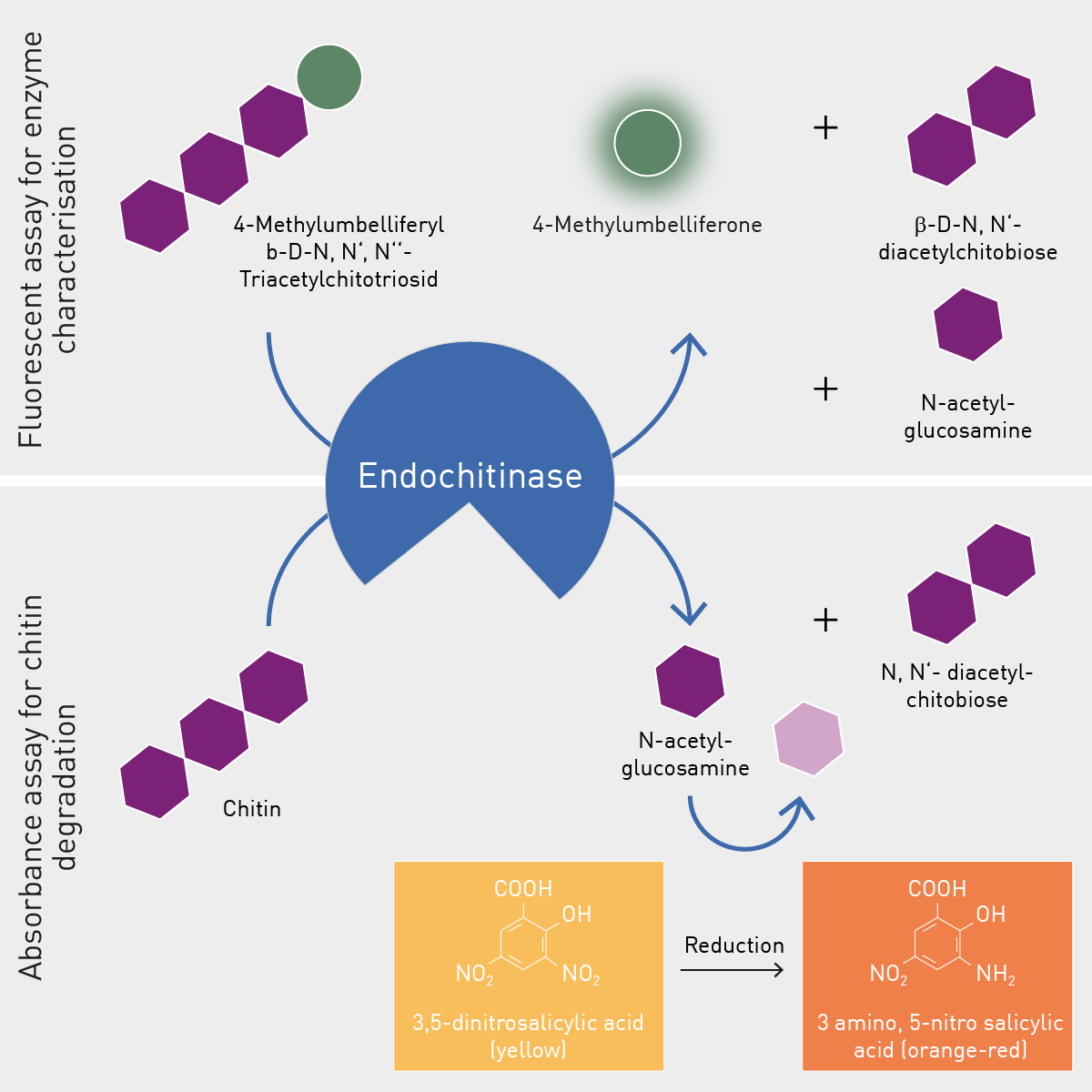
In the fluorescence-based enzymatic activity assay (Fig. 1A), 4-methylumbelliferyl-N,N′,N″-triacetyl-β-chitotrioside (4-MUChT) is metabolised to three N-acetylglucosamine units and 4-methy-lumbilliferone (4-MU). 4-MU shows substantial fluorescence emission at 445 nm upon excitation at 365 nm.
DNS assay
For the degradation of colloidal chitin from shrimp shells, natural chitin functions as educt for the endochitinase. Cleavage of chitin by this endochitinase produces mainly N,N′-diacetylchitobiose along with minor amounts of N-acetylglucosamine (Fig. 1B). In turn, N-acetylglucosamine reduces the yellow assay reagent 3,5-dinitrosalicyclic acid (DNS) to the orange/red 3-amino, 5-ni-trosalicyclic acid which can be quantifi ed by absorbance measurement on a microplate reader.
Materials & methods
- 4-MUChT/4-MU (Merck, #M5639, #M1381)
- DNS reagent
- α-chitin from shrimp shells (Carl Roth, #8845.1)
- 96-well plate, black (Carl Roth, #CEK8.1)
- 96-well plate, transparent (Carl Roth, #9293.1)
- CLARIOstar Plus (BMG LABTECH)
Experimental Procedure
Recombinant endochitinase Chit36-TA was expressed and purified. The fluorometric 4-MUChT assay was performed for the biochemical characterisation of Chit36-TA. 30 µL enzyme was preincubated with 70 µL acetate buffer (50 mM, pH 4.5) for 2 min at 40 °C. 20 µL 120 mM 4-MUChT were added, and the mixture was incubated at 40 °C with shaking for 5 min. The reaction was terminated by adding 120 µL 500 mM sodium carbonate. Free 4-MU was quantified in fluorescence intensity detection mode on the CLARIOstar Plus using a 4-MU standard series. Thermal stability was determined after incubating the enzyme solution at 40–75 °C for 15 min with subsequent cooling on ice.
For direct hydrolysis, 1% (w/v) colloidal chitin from shrimp shells was incubated with 4% (w/v) enzyme under optimal conditions. After defined time intervals (0-24 h), 200 µL samples were taken, inactivated and centrifuged. 150 µL supernatant and 150 µL DNS reagent were mixed and heated to 100 °C for 10 min. 200 µL of the mixture were measured in a 96-well plate on the CLARIOstar Plus using absorbance detection.
Instrument Settings
|
Absorbance, plate mode
|
||
|
Optic settings |
Spectrometer |
405 nm |
|
General settings |
Flashes |
22 |
|
Kinetic settings |
Number of cycles |
90 |
|
Cycle time |
40 s |
|
|
Incubation |
Target Temperature |
37 °C |
Results & Discussion
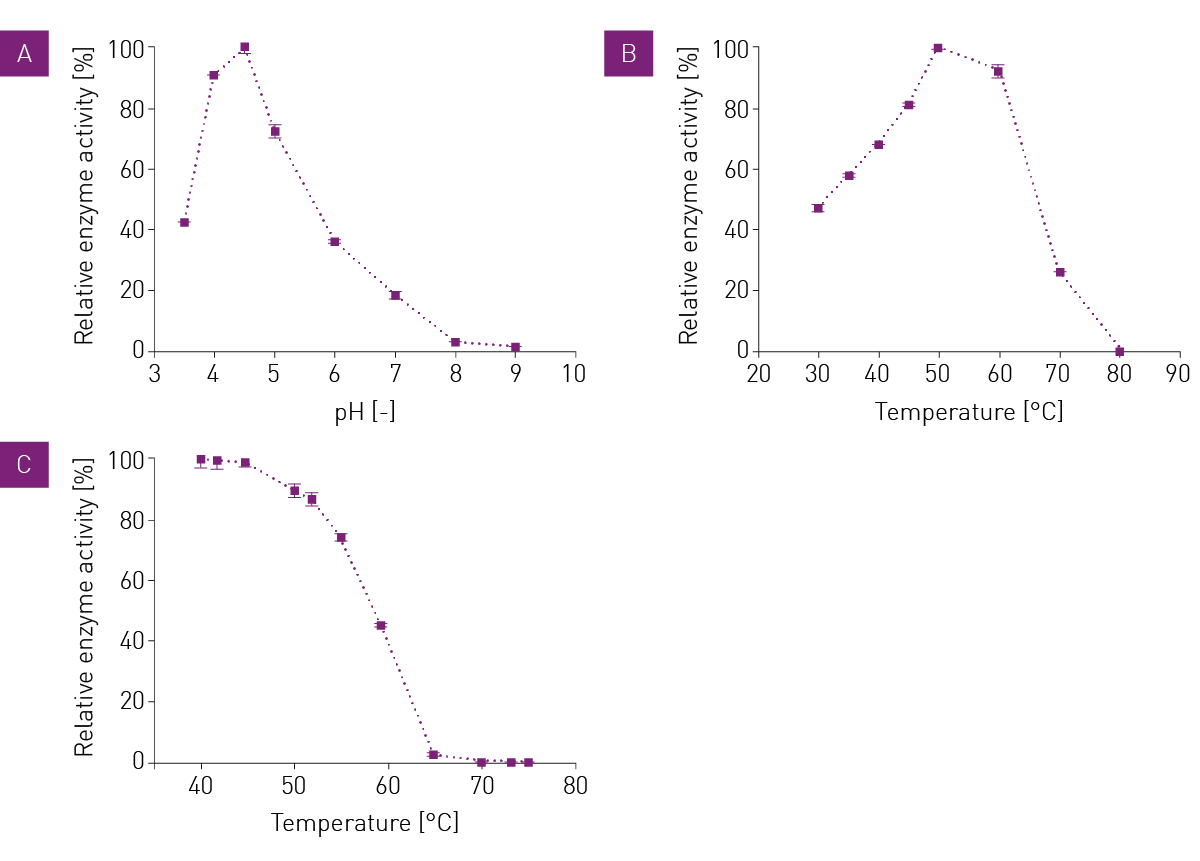
Endochitinase Chit36-TA exhibited maximum activity at pH 4.5 and 50 °C – short term (Fig. 2A,B). Even at 60 °C, the remaining activity of Chit36-TA was >93%. The activity declined to 26% at 70 °C (Fig. 2C).
Colloidal chitin from shrimp shells was hydrolysed at optimal temperature and pH for Chit36-TA (40 °C, pH 4.5). Figure 3 shows the degree of hydrolysis of colloidal chitin from shrimp shells. The initial hydrolysis rate is 1.16 g/L*h. Subsequent hydrolysis rates decreased after about 1–2 h. Chemical hydrolysis with hydrochloric acid was performed as a reference in parallel and yielded a value of 8.1 g/L.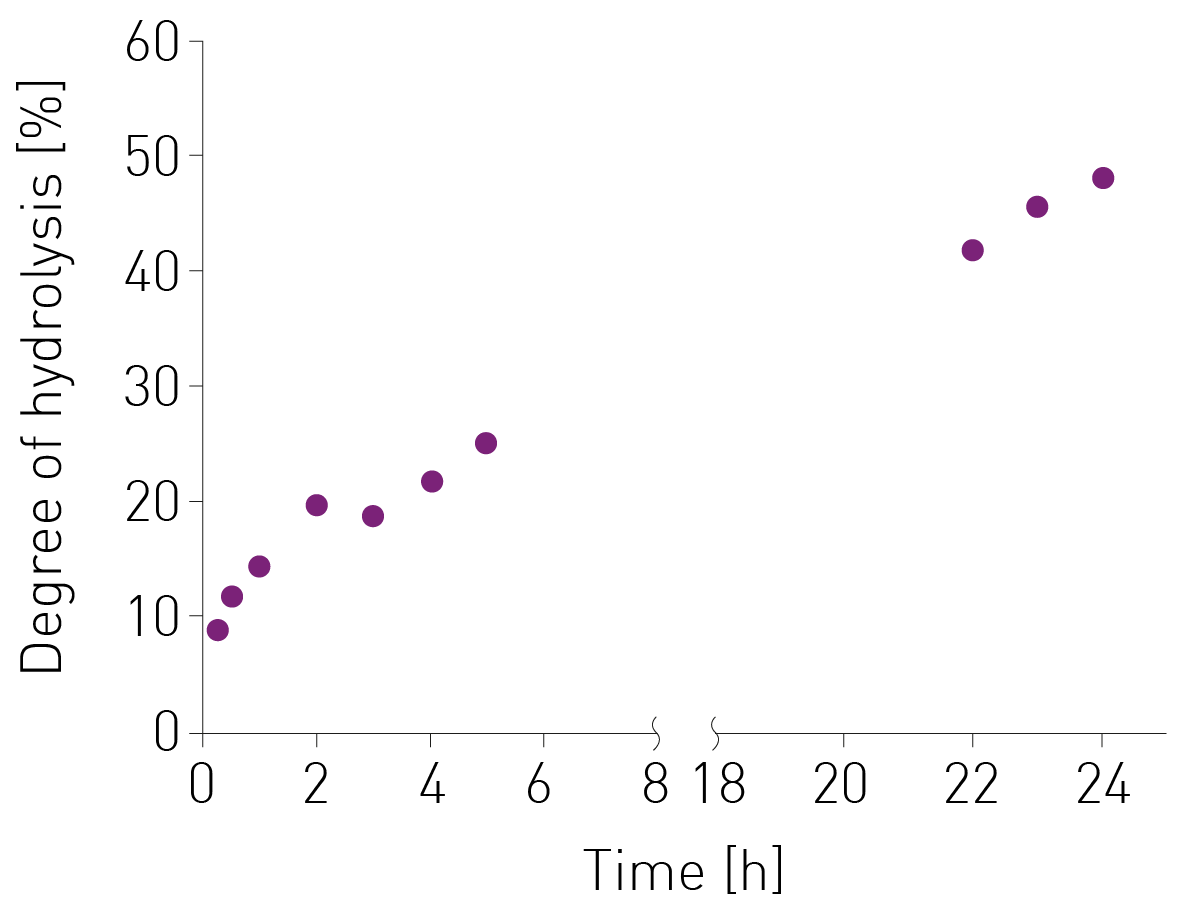
Conclusion
Enzymatic hydrolysis of shrimp shells yielded chitin as an abundant resource for sustainable N-acetylglucosamine oligomer production from otherwise unused waste products. In this approach, enzymatic chitin hydrolysis from colloidal chitin from shrimps was demonstrated for the first time using recombinantly expressed endochitinase Chit36-TA.
The multimode reader CLARIOstar Plus is an ideal platform to perform diverse assays for the characterisation and validation of novel enzymes with potential for chitin degradation. In addition to analysis in absorbance, fluorescence intensity and other detection modes, the CLARIOstar Plus is also able to fulfil tasks in the assay preparation steps that involve shaking and heating and can be readily used to test a wide range of assay conditions including the influence of environmental temperature, for example, on enzyme activity.
References
- Hahn T., et al. (2020) Current state of chitin purifi cation and chitosan pro- duction from insects. J. Chem. Technol. Biotechnol. 95:2775–2795. https:// doi. org/ 10. 1002/ jctb. 6533.
- Suryawanshi, N., Jujjavarapu, S.E. & Ayothiraman, S. (2019) Marine shell industrial wastes – an abundant source of chitin and its derivatives: constituents, pretreatment, fermentation, and pleiotropic applications – a revisit. Int. J. Environ. Sci. Technol. 16:3877–3898. https://doi.org/10.1007/s13762-018-02204-3.
- Ngo, D., et al (2009) Production of chitin oligosaccharides with different molecular weights and their antioxidant effect in RAW 264.7 cells. J. Funct. Foods 1:188–198. https:// doi. org/ 10. 1016/j. jff. 2009. 01. 008.
- Patra, J.K., Das, G., Shin, H.-S. (eds) (2018) Microbial Biotechnology: Volume 2. Application in Food and Pharmacology, Springer eBook Collection, Springer Singapore, Singapore. https://doi.org/10.1007/978-981-10-7140-9
- Gebele, L., et al. (2024) Recombinant expression and characterization of the endochitinase Chit36-TA from Trichoderma asperellum in Komagataella phaffi i for chitin degradation of black soldier fl y exuviae. Bioprocess Biosyst. Eng. Oct;47(10):1751-1766 https://doi.org/10.1007/s00449-024-03067-4.