







Introduction
Different analytical approaches in clinical immunology and drug discovery take advantage of two closely related techniques based on light scattering.
Turbidimetry is the measurement of light transmitted through a suspension of particles. It requires relatively higher concentrations of particles and obeys Beer’s Law. In contrast, nephelometry is a direct method of measuring light scattered by particles suspended in solution at right angles to the beam, or preferably, at a forward angle. In dilute solutions, where absorption and reflection are minimal, the intensity of the scattered light is a function of the concentration of scattering particles.
The most common application of laser-based nephelometry in microplate format is the fully automated solubility screen in HTS laboratories. Determining aqueous compound solubility has become an essential early measurement in the drug discovery process to avoid time-consuming and costly ADME screens of low solubility compounds.
In clinical chemistry, nephelometry is used to determine serum immunoglobulin (IgA, IgG, IgM), complement components (C3, C4), acute phase reactant proteins (CRP, transferrin), albumin and a-1-antitrypsin. Protein precipitation of globular proteins refers to the formation of protein aggregates by adding salt (ammonium sulphate), organic solvent (acetone), organic polymer (PEG) or trichloro-acetic acid. In contrast, immuno-precipitation allows for a given protein to be precipitated selectively via an antibody-antigen reaction.
In organic chemistry, nephelometry is used to quantify macromolecules, e.g. monitoring of a polymerisation reaction.
Materials & Methods
As an alternative to the common cuvette based instruments BMG LABTECH offers the only laser-based microplate nephelometer, the NEPHELOstar® Plus, which detects particulate matter within microplate wells via forward light scattering (optical design is described in figure 1).
The light source of the NEPHELOstar Plus is a red laser diode (633 nm) which offers adjustable intensity and beam diameter to reduce meniscus effects and optimized sensitivity allowing to measure even in 384- well plate format. Instrument flexibility is further enhanced by two built-in reagent injectors, precise temperature control, multimode shaking capabilities, automatic gain adjustment, and a robotic plate carrier.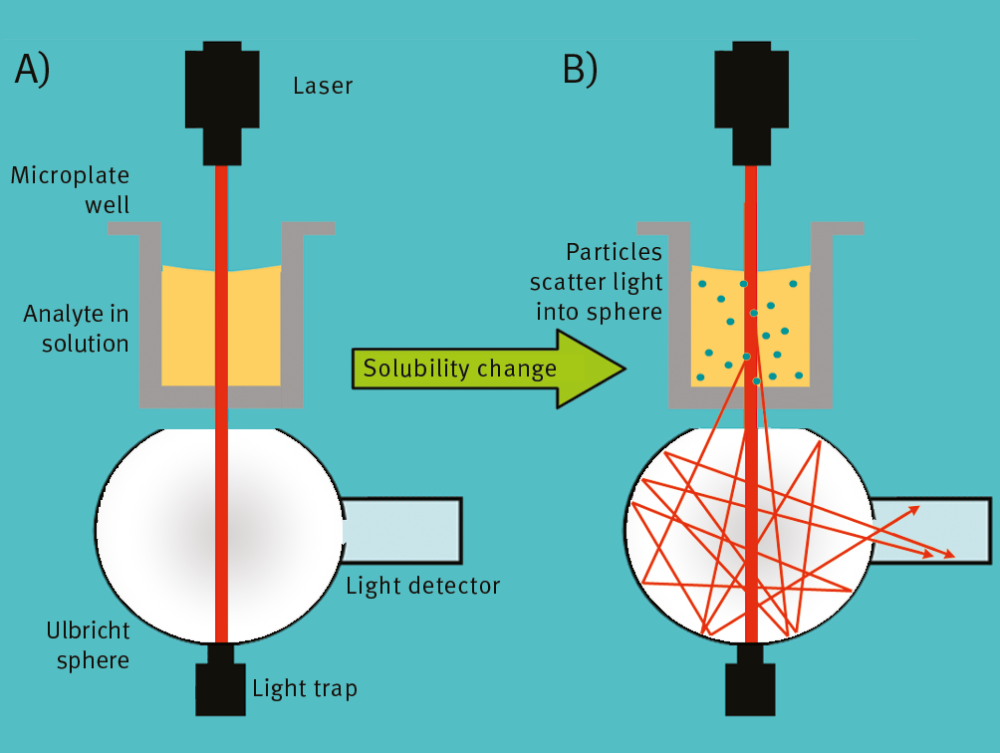
A fast and sensitive method of analyzing growth phase regulation of the Corynebacterium glutamicum wild type and different deletion mutants by continuous monitoring of microbial growth on a medium supplemented with different sulphur sources is described below. Corynebacterium glutamicum is a Gram-positive, non pathogenic and fast growing soil bacterium which is used for industrial amino acid and vitamin production. Cells were precultured on modified minimal medium E (MMES) supplemented with different suitable sulphur sources at 30°C in a rotary shaker (300 rpm), and the optical densities at 600 nm of these cultures were measured. These precultures were used to inoculate 100 μL of growth media (MMES + 0.1 mM sulphur source, start OD of 0.01) using the microplate Cellstar, 96 Well Suspension Culture Plate (GreinerBioOne). To avoid evaporation and condensation the plates were sealed with transparent, hydrophobic and gas permeable plastic films (Breathe-Easy, Roth) during incubation and measurement.
The growth curves were recorded by monitoring the turbidity of the cultures using the NEPHELOstar Plus. The laser intensity was adjusted to 50% and the laser beam focus to 2.5 mm. Incubation temperature was 30°C, and between measurement cycles the plate was orbitally shaken with a shake width of 3 mm.
Results & Discussion
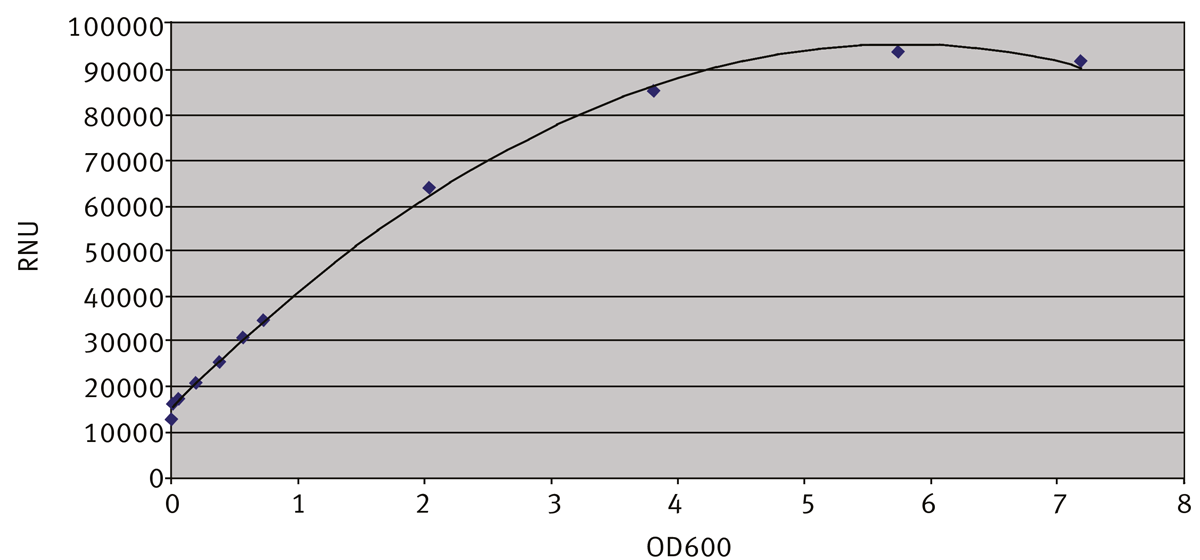
In earlier experiments the comparability of the data obtained by optical density methods was assured using a transmission reader with data obtained by measuring the scattering of light using a nephelometer. A serial dilution of the C. glutamicum culture was made and turbidity determined by measuring both the optical density and the forward scattered light. Fig. 2 shows a good correlation between the two methods, which is almost linear up to 4 OD.
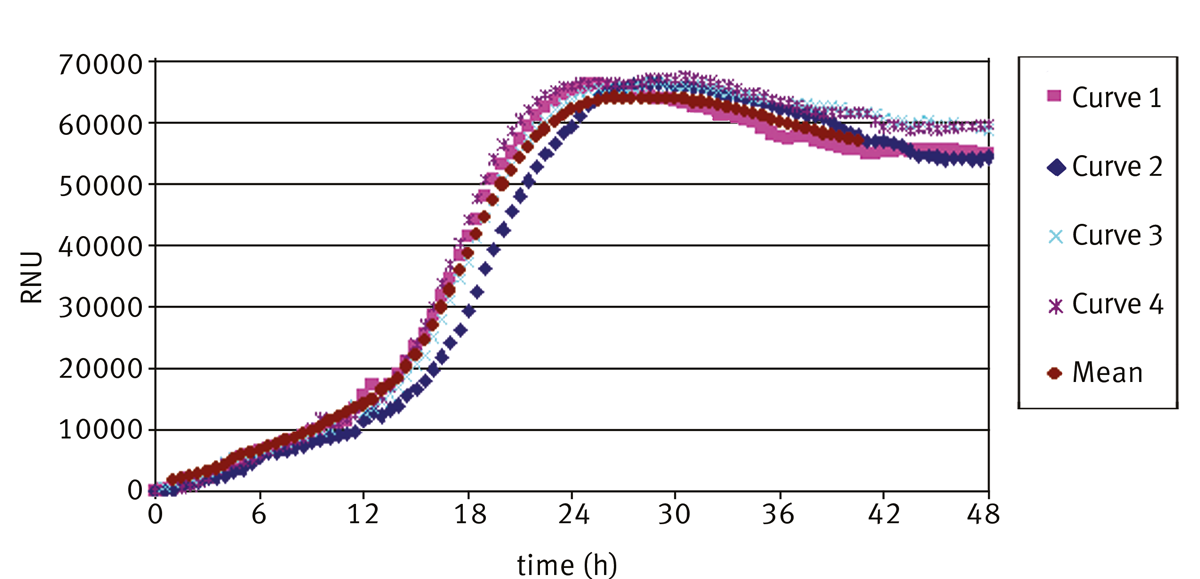
The great reproducibility of the nephelometric assay is demonstrated in figure 3, which shows four independent growth curves of a C. glutamicum culture. In this graph six replicates were used for each curve plotted against time and including the mean of these four growth curves.
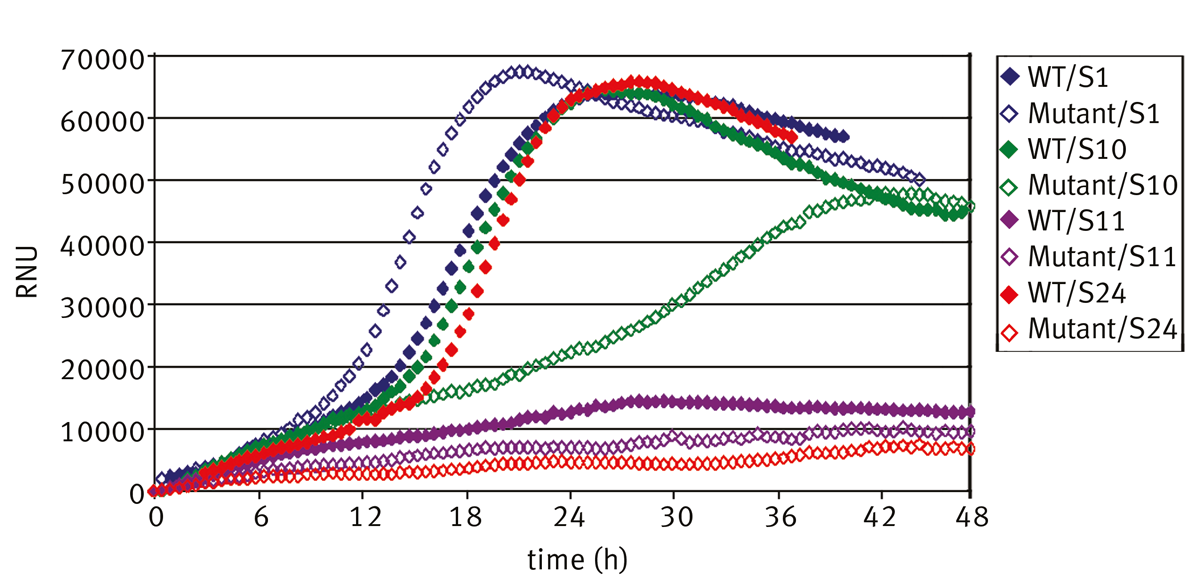
Finally, figure 4 demonstrates a concrete biological application of nephelometry in bacterial growth regulation. It shows the growth curves of the C. glutamicum wild type and a deletion mutant, which has a deleted gene for a regulatory protein. Both strains are cultured on minimal medium supplemented with different sulphur sources (S1, S10, S11, and S24). The plotted growth curves show that the deletion mutant, compared to the wild type, grows better on S1 but worse on S10 and no more on S24.
Conclusion
The described application reveals that laser nephelometry is a reliable technique for monitoring microbial growth besides the classical applications like compound solubility testing and immunoprecipitation. Studies show that the nephelometric assay, compared to the turbidimetric assay, is not only comparable, but clearly superior regarding sensitivity. The key advantage of nephelometry is the ability to detect scattered light, even if the concentration of scattering particles is very low, which is the case during the lag phase and beginning of the log phase. Using the NEPHELOstar Plus, instead of a traditional transmission reader, this early part of the growth curve can be monitored much more accurately.