


A microplate that Looks out of a microplate reader A microplate that Looks out of a microplate reader

Microplate spectrophotometer for fast and flexible analysis

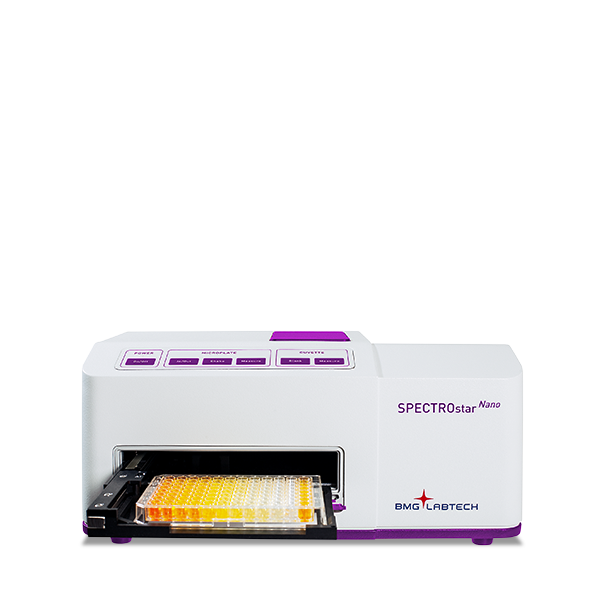
Looking for a fast, easy-to-use absorption spectrophotometer that can readily capture full spectra? Discover what the SPECTROstar® Nano has to offer.

Trusted and loved by:customer-logos


The SPECTROstar® Nano microplate spectrophotometer for rapid full-spectrum absorbance

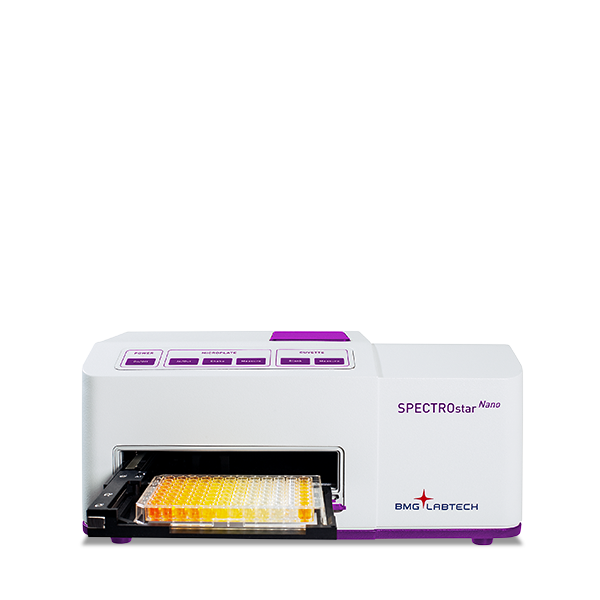
The SPECTROstar® Nano from BMG is a revolutionary Microplate Spectrophotometer for absorbance measurements. The flexibility it provides makes it easy to perform low-volume absorbance assays at speeds like no other absorbance-only reader on the market.


Features of our Microplate Spectrophotometer:


  • Analyze ELISAs, enzyme kinetics, microbial growth, and even cell-based assays with a single instrument
  • Read different chromophores without the need to purchase extra filters
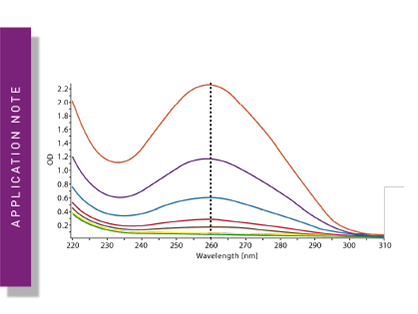
  • Acquire a full UV/vis spectrum in the same amount of time you would need for one wavelength 
  • Ultrafast UV/vis spectral acquisition: from 220 – 1000 nm in < 1 second/well
  • Alternatively, you can simultaneously acquire 8 distinct wavelengths in  < 1 second/well
  • Compatible with microplate formats up to 1536-wells 
  • Precise temperature control and multiple shaking options
  • Modular and upgradeable to multi-mode plate readers
  • Predefined protocols also make it possible to read ELISAs, RNA, DNA, protein, cell growth, and more 
  • Instantly capture full spectra for low volumes, microplates, and cuvettes
  • Made-in-Germany dependability
Microplate reader SPECTROstar Nano

Technical Specifications

Detection modes

UV/vis absorbance spectra

Measurement modes

Endpoint and kinetic
Spectral scanning (absorbance)
Well scanning

Microplate formats

6 to 1536-well plates, user-definable
LVis Plate with 16 low-volume microspots (2 μL)

Microplate carrier

Robot compatible

Light sources

High energy xenon flash lamp

Detectors

CCD Spectrometer

Wavelength selection

UV/vis absorbance spectrometer
Full spectra or 8 distinct wavelengths in < 1 sec/well

Spectral range

220 - 1000 nm; wavelength precision: ≤ 0.5 nm

Sensitivity

Selectable spectral resolution: 1, 2, 5, and 10 nm
OD range: 0 to 4 OD; photometric resolution: 0.001 OD
Accuracy: < 1% at 2 OD
Precision: < 0.5% at 1 OD and < 0.8% at 2 OD
Linearity: ≤ 0.8% at 2.0 OD

Read times

Full spectrum from 220 to 1000 nm in less than 1 sec/well

Shaking

Linear, orbital, and double-orbital with user-definable time and speed

Purge gas vent

System to inject an atmosphere or to pull a vacuum into the reader

Incubation

+3 °C above ambient up to 45 °C

The upper heating plate of the incubation chamber operates at 0.5 °C more than the lower plate. This prevents condensation build-up on the lid or sealer

Software

Multi-user Reader Control and MARS Data Analysis Software included
FDA 21 CFR Part 11 compliant

Dimensions

Width: 36 cm, depth: 50 cm, height: 16 cm; weight: 10 kg

Power requirements
  • External Power Supply
  • Input Voltage: 100 or 115 or 230 V,  50/60 Hz, auto ranging
  • Output Voltage: 24V DC / 2.5A
Power consumption
  • Standby 0 W (<0,5W)
  • Idle Mode 5 W
  • Measuring 15 W   
  • Maximum 60 W
Optional Accessories
LVis plate

Sample capacity: sixteen separate microdrop wells for 2 µL samples; one standard cuvette position for up to 1 mL samples

Quality control internal standards (optional): four NIST traceable optical density filters (approximate values of 0.1, 0.3, 0.6 and 1.0 OD); one holmium oxide filter for wavelength accuracy

Dimensions: conforms to SBS standards for microplates

THERMOstar

Microplate incubator and shaker

*
The SPECTROstar Nano is for research use only.

Testimonial

nick-bland-300x300-kreis

Nick Bland, Group Leader at Domainex, Cambridge, UK


“We just ran HTS of several hundred thousand compounds using a TR-FRET assay on a PHERAstar with Z´ in the region of 0.9, every time an excellent confirmation of hits.”

Application Notes

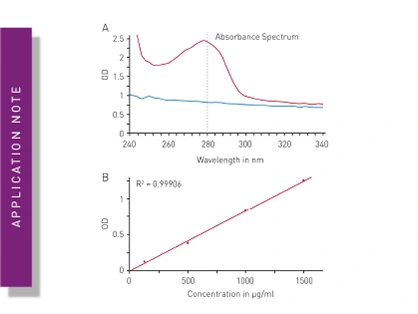
See how scientists and researchers are using BMG Labtech’s SPECTROstar® Nano spectrophotometer

Frequently asked questions

  • What is a microplate spectrophotometer?

    A microplate spectrophotometer measures UV/vis absorbance across all wells of a microplate, quantifying how much light is absorbed at specific wavelengths. Results are expressed in Optical Density (OD) units and used to calculate analyte concentration via the Beer-Lambert law or a standard curve. Common formats include 96-, 384-, and 1536-well plates.
  • What are the key features of a spectrophotometer?

    Key features to evaluate include: detector type (CCD vs PMT), wavelength range and resolution, supported plate formats (96, 384, 1536-well), read speed, shaking and incubation options, cuvette compatibility, and the depth of the bundled data analysis software.
  • What is the difference between a plate reader and a spectrophotometer?

    A traditional spectrophotometer measures one sample at a time in a cuvette. A plate spectrophotometer applies the same absorbance measurement principle to a microplate, allowing 96 to 1536 samples to be measured in a single run - increasing throughput and reducing reagent volumes significantly.
  • Which applications can benefit from using a spectrophotometer?

    It is ideal for microplate-based applications such as colorimetric assays, enzymatic assays, ELISA, nucleic acid quantification, protein assays, cell-based assays with appropriate reagents, and kinetic/endpoint measurements.
  • What is a 96 well plate spectrophotometer?

    A 96 well plate spectrophotometer reads absorbance from all 96 wells of a standard microplate in a single measurement run. It is the most common format for routine assays including ELISA, Bradford protein quantification, and OD600 bacterial growth monitoring.
  • Are microplate spectrophotometers compatible with different types of microplates?

    Common formats include 6-, 12-, 24-, 48-, 96-, and 384-well plates. Some models also support 1536- or even 3456-well plates.
  • Can spectrophotometers be integrated into existing laboratory systems?

    Not all spectrophotometers have compatibility with automation systems for high-throughput screening and seamless integration into laboratory automation setups. BMG LABTECH's spectrophotometers are fully compatible with modern laboratory automation systems.
Newsletter Sign-up