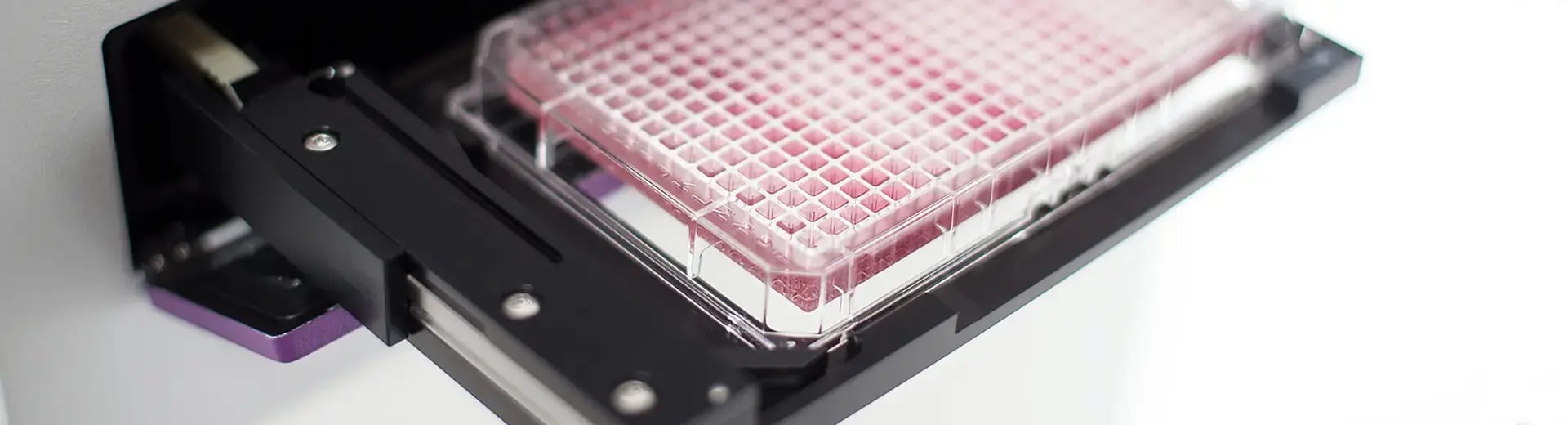

A microplate that Looks out of a microplate Reader A microplate that Looks out of a microplate Reader

High‑Performance Luminescence Detection in One Flexible Microplate Reader

Our luminescence microplate readers are designed to deliver high sensitivity, low background noise, and rapid, reliable detection to enable researchers to generate accurate data with confidence.

Trusted and loved by:

customer-logos


Reliable Luminescence Measurements Across Assays

Our luminescence plate readers give you the sensitivity, flexibility, and dynamic range needed to get the most out of your luminescence assays, with features including:


  • Detect flash, glow, Dual Luciferase® Reporter and BRET assays
  • Better sensitivity provides better statistic, less variability among replicates, and a larger assay window
  • DLReady™ certified luminometer plate readers
  • Up to 8 decades dynamic range in one measurement with EDR technology
  • Filters or monochromators for emission wavelength selection
  • Simultaneous Dual Emission detects two BRET channels simultaneously
  • Injectors to start/stop reactions 
  • Compatible with microplate formats up to 1536-wells for high-throughput
  • Made-in-Germany dependability
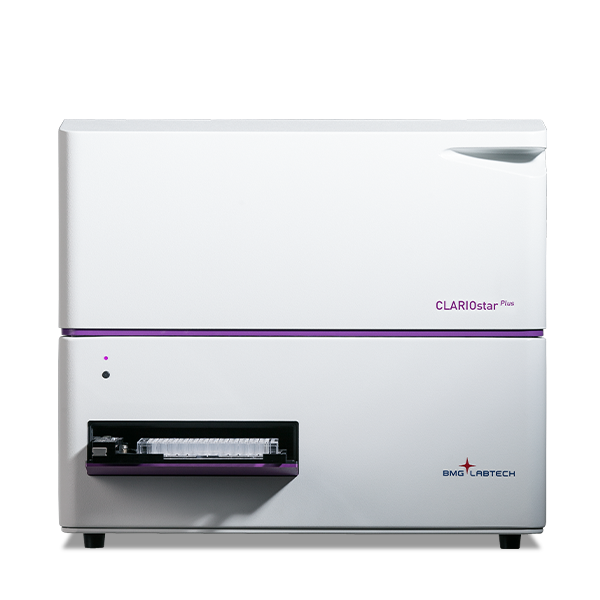
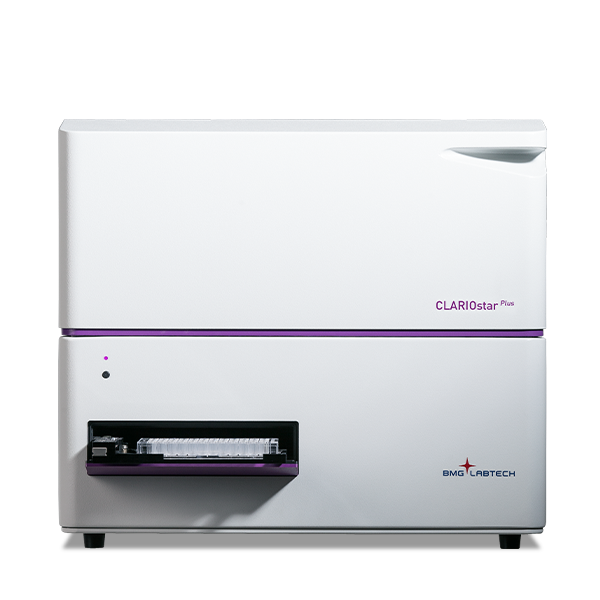
Microplate reader CLARIOstar Plus

Technical specifications

Detection modes

Fluorescence intensity (incl. FRET)
Fluorescence polarization
AlphaScreen®/AlphaLISA®/AlphaPlex™
Luminescence (flash and glow) - incl. BRET
Time-resolved fluorescence
TR-FRET
UV/vis absorbance spectra

Measurement modes

Top and bottom reading
Endpoint and kinetic
Sequential multi-excitation
Sequential multi-emission
Spectral scanning (fluorescence, luminescence, absorbance)
Ratiometric measurements
Well scanning

Microplate formats

6- to 1536-well plates, user-definable
LVis Plate with 16 low volume microspots (2 μL)

Microplate carrier

Robot compatible

Light sources

High energy xenon flash lamp
Dedicated laser for AlphaScreen®/AlphaLISA®/AlphaPlex™

Detectors

Low-noise photomultiplier tube
Red-shifted photomultiplier tube
CCD spectrometer

Wavelength selection

Dual Linear Variable Filter (LVF) Monochromators™
Linear Variable Dichroic Mirror
Separates ex & em LVF Monochromators

Optical filters:
Ex and em slides hold 4 filters each
LVF Monochromators + optical filters
Use one for ex and the other for em
UV/Vis absorbance spectrometer:
Full spectra or 8 distinct wavelengths in < 1 sec/well

Spectral range

Filters
FI, FP, TRF: 240 - 740 nm or 240 - 900 nm (red-shifted PMT)
LUM: 240 - 740 nm

LVF Monochromators™
FI: 320 - 740 nm or 320 - 840 nm (red-shifted PMT)
LUM: 320 - 740 nm

Linear Variable Dichroic
340 - 740 nm or 340 - 760 nm (red-shifted PMT)

Spectrometer
ABS: 220 - 1000 nm; wavelength precision: ≤ 0.5 nm

Sensitivity

FI filters
(top)
< 0.15 pM (< 3 amol/well FITC, 384sv, 20 μL).

FI filters
(bottom)
< 1.0 pM (< 50 amol/well FITC, 384g, 50 μL).

FI monochromator
(top)
< 0.35 pM (< 7 amol/well FITC, 384sv, 20 μL).

FI monochromator
(bottom)
< 3.0 pM (< 150 amol/well FITC, 384g, 50 μL).
Dynamic Range: 8 decades in a single measurement.

FP
< 0.5 mP SD at 1 nM FITC (384sv, 20 μL).

HTRF®
(black and white microplates)
Reader Control Kit (Eu) after 18h (384sv, 20 μL).
Delta F > 880% (High Calibrator).
Delta F > 30% (Low Calibrator).

TRF
< 20 fM europium, 384, 80 μL (<1.6 amol/well).

LUM
< 0.4 pM (< 8 amol/well ATP, 384sv, 20 μL).
Dynamic range: 8 decades in a single measurement.

AlphaScreen® with laser.
< 5 pM (< 100 amol/well P-Tyr-100, 384sv, 20 μL).

ABS with spectrometer.
Selectable spectral resolution: 1, 2, 5, and 10 nm.
OD range: 0 to 4 OD; photometric resolution: 0.001 OD.
Accuracy: < 1% at 2 OD.
Precision: < 0.5% at 1 OD and < 0.8% at 2 OD.
Linearity: ≤ 0.8% at 2.0 OD.

Read times

Flying mode (1 flash)
8 s (96), 15 s (384), 28 s (1536)

10 flashes
19 s (96), 57 s (384), 3 min 4 s (1536)

Shaking

Linear, orbital, and double-orbital with user-definable time and speed

Incubation

+3 °C above ambient up to 45 °C or 65 °C

The upper heating plate of the incubation chamber operates at 0.5 °C more than the lower plate. This prevents condensation build-up on the lid or sealer

Software

Multi-user reader control (SMART Control and Voyager) and data analysis software (MARS). Voyager is compatible with CLARIOstar Plus readers from serial number 430-4001. 

FDA 21 CFR Part 11 compliance available with SMART Control and MARS.

Integrated fluorophore library.

Dimensions

Width: 45 cm, depth: 51 cm, height: 40 cm; weight: 32 kg

Optical filters

Excitation and emission slides for 4 filters each

Optical path guides

Top and bottom: free-air optical light path guided by motor-driven mirrors and dichroics

Z'adjustment

Automatic focal height adjustment (0.1 mm resolution)

Reagent injection

Up to 2 built-in reagent injectors
Individual injection volumes for each well: 3 to 500 µL (optionally up to 2 mL)
Variable injection speed up to 420 µL/s
Reagent back flushing

Integrated barcode reader

Up to two integrated barcode readers

Power requirements
  • 100 or 115 or 230 V, 50/60 Hz, auto ranging
Power consumption
  • Normal operating conditions: 50 W
  • Idle State: 20W
  • Switched off: 0W
  • max. 300 VA
Optional Accessories
LVis plate

Sample capacity: sixteen separate microdrop wells for 2 µL samples; one standard cuvette position for up to 1 mL samples

Quality Control Internal Standards (optional): four NIST traceable optical density filters (approximate values of 0.1, 0.3, 0.6 and 1.0 OD); one holmium oxide filter for wavelength accuracy

Dimensions: conforms to SBS standards for microplates

THERMOstar

Microplate incubator and shaker

Atmospheric control unit

Actively regulates O2 and CO2 - 0.1-20%

Stacker

Magazines for up to 50 plates - continuous loading feature. Only compatible with SMART Control.

Optical filters

Excitation and emission filters

Upgrades

The CLARIOstar Plus can include all or any combination of features listed below at purchase. Upgrading with additional features is possible at any time

Please contact your local representative for more details or a quote

*

LOD = 3 x SD (20 blanks) / slope (6 pt std curve)
AlphaScreen® P-Tyr-100 assay kit, PerkinElmer, #6760620C
Microplates: white for LUM, AlphaScreen®, TRF; black for FI, FP; clear for ABS
96 = 96-well microplates
384sv = 384-well small volume microplates
384g = 384-well glass bottom microplates
1536 = 1536-well microplates

The CLARIOstar Plus is for research use only.

Customer Reviews

anonym-icon-female

Caterina Collodet, PhD Researcher, KTH Royal Institute of Technology, Sweden


"Great product, easy-to-use instrument and software, simple setup of protocols, and export data. High reproducibility among replicates. I was pleased by the fast costumer support [...]. This instrument has been running for more than 5 years. Good value for money."

Application Notes

See how scientists and researchers are using BMG LABTECH’s microplate readers to advance their research.

Frequently asked questions

  • What is the luminescence plate reader offered by BMG LABTECH?

    The luminescence plate reader by BMG LABTECH is a sophisticated instrument designed for high-sensitivity detection of luminescent signals produced by chemiluminescence or bioluminescence reactions in microplate formats.
  • What are the key features of this luminescence plate reader?

    Key features include high sensitivity, wide dynamic range, flash & glow luminescence detection, top and bottom reading, endpoint and kinetic measurements, compatibility with multiple plate formats, and advanced data analysis software to facilitate precise measurements.
  • In which fields or applications can this luminescence plate reader be used?

    Luminescence plate readers are widely used in drug discovery, molecular biology, biochemistry, and other life science research areas. Applications include promoter assays, luciferase reporter assays, ATP quantification, apoptosis assays, kinase activity, protein-protein interaction tests, etc.
  • How does a luminescence plate reader differ from a fluorescence plate reader?

    Luminescence readers detect light emitted by samples without previous light excitation, while fluorescence readers require an excitation light source to excite samples and measure then emitted light.
  • Is the luminescence plate reader compatible with different types of microplates?

    Yes, it supports various microplate formats including 96-well, 384-well, and other standard plates to accommodate diverse experimental needs. HTS readers are also compatible with 1536-well plates.
  • Can a multimode plate reader detect luminescence?

    Yes, most modern multimode plate readers include luminescence detection alongside absorbance and fluorescence modes. This makes them a highly practical choice for labs running diverse assay types, as a single instrument can handle multiple workflows without sacrificing performance. However, it's worth checking the instrument's luminescence-specific specifications carefully - particularly sensitivity and dynamic range - as dedicated luminescence readers can sometimes outperform multimode instruments on those metrics. For labs where luminescence is the primary detection mode, a dedicated reader may be preferable, but for general-purpose labs, a well-specified multimode reader offers excellent value and flexibility.
  • How sensitive are luminescence plate readers?

    Luminescence plate readers are among the most sensitive detection instruments available in the lab, largely because luminescence produces no background excitation light - unlike fluorescence - which dramatically improves signal-to-noise ratio. High-quality instruments can detect signals in the attomole to femtomole range, making them ideal for low-abundance targets and highly sensitive cell-based assays. Sensitivity varies between models, so key specs to compare include the detection limit, signal-to-noise ratio, and dynamic range. Top-tier readers offer a dynamic range of up to eight orders of magnitude, allowing accurate measurement across both very weak and very bright luminescence signals.
  • What plate colour should I use for luminescence assays?

    White plates are the standard recommendation for luminescence assays because their reflective surface amplifies the already-weak light signal, improving sensitivity and overall read quality. Grey plates offer a middle-ground option - they boost signal similarly to white plates while also reducing well-to-well crosstalk, which is particularly useful in high-density formats like 384- or 1536-well plates. Black plates are generally avoided for luminescence as they absorb light and reduce signal intensity, though they can be useful in specific scenarios involving very bright assays where crosstalk is a greater concern than raw sensitivity. Always match plate colour to your assay's signal strength and format.
Newsletter Sign-up