






Introduction
Reactive oxygen species (ROS) are essential inter-mediates in oxidative metabolism. Nonetheless, when generated in excess, ROS can damage cells by peroxidizing lipids and disrupting structural proteins, enzymes, and nucleic acids.
Excess ROS are generated during a variety of stresses on cells including ischemia/reperfusion, exposure to ionizing and ultraviolet radiation, and/or inflammation. Reactive oxygen species may contribute to inflammation and tissue damage. (e.g.: Oxidation of polyunsaturated lipids in cell membranes). Attack by a free radical on one of the carbon to carbon double bonds can lead to the formation of the corresponding lipid peroxy radical and the initiation of a chain reaction in which the final products, lipid peroxides, no longer maintain the integrity of the cell wall.
This process, lipid peroxidation, may be initiated by the hydroxyl radical OH in a reaction in which iron, as Fe2+, is involved. In biological systems, much attention is focused on the two free radicals, superoxide anion and hydroxyl radical.
The generation processes of ROS can be monitored using luminescence. Because of the very weak native luminescence of ROS, both luminol and lucigenin have been used in the past to give measurable signals. However, the luminescence of these two substances is very small compared to that of Pholasin®, which allows precise analysis on very small samples.
Pholasin® is the photoprotein of the marine rockboring bioluminescent mollusc, Pholas dactylus, and the Common Piddock. Pholasin® does not glow on its own but can be switched on by free radicals and other reactive oxygen species. The capacity of samples to scavenge free radicals and other oxidants can be monitored by means of the described test kit that contains Pholasin®.
Materials & Methods
All materials were obtained through normal distribution channels from the manufacturer stated.
- BMG LABTECH microplate reader with luminescence detection and injectors
- 96-well plate, white
- Samples of unknown antioxidant capacity
- Test kit KSL-ABEL-21 M2, Knight Scientific Limited Website: www.knightscientific.com
In addition, consumables such as pipette tips and tubes were used as needed from various manufacturers.
Protocol for Antioxidant Test for Superoxide
Superoxide is generated instantaneously when Solution B is added to Solution A. By means of the reagent injector Solution B is injected into the microplate containing Solution A together with Pholasin®, with and without a 10 μL sample of fluid of unknown antioxidant capacity.
Into a microplate well add the following:
- 25 μL Assay Buffer (for controls) or 15 μL Assay Buffer + 10 μL sample
- 50 μL Antioxidant Pholasin®
- 100 μL Solution A
The assay is initiated when 25 μL of Solution B is injected into the microplate well, which must be in the light measuring position.
The assay is carried out using the following parameters: Gain = 3300-3500 depending on reader, well mode, No. of intervals = 32, Meas. Interval Time = 1 s, Total Meas. Time = 32 s, Start injection = 0 s
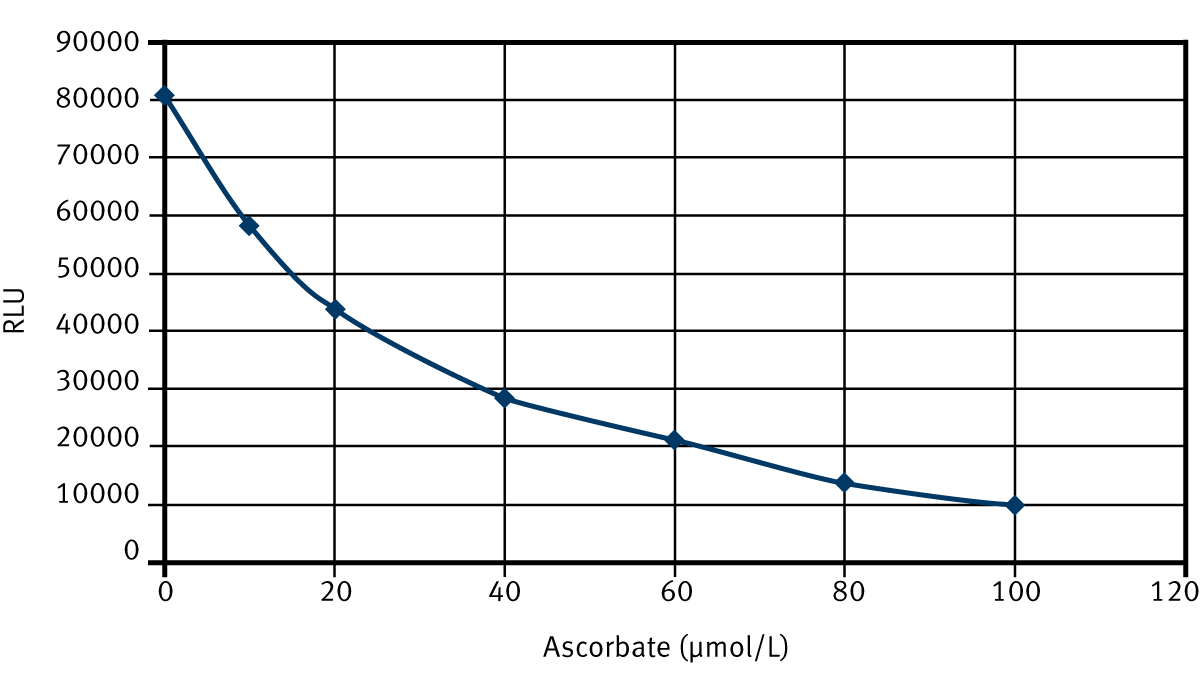
Standard curve for Ascorbate
Pipette into a microplate well:
- 50 μL Pholasin
- 5 μL Reconstitution and Assay buffer (R&A)
- 100 μL Solution A
Using the 2 built-in reagent injectors of the BMG LABTECH microplate reader the dilution series of ascorbate can be generated automatically. Injector 1 is programmed with the volumes of 1 mmol/L ascorbate solution and injector 2 with the volumes of R&A buffer as shown in Table 1.
Table 1: Volumes of ascorbate and R&A buffer added to microplate for recording a standard curve.
| 1 mmol/L ascorbate (µL) | R&A Buffer (µL) | Ascorbate (µmol/L) in 200 µL |
| 0 | 20 | 0 |
| 2 | 18 | 10 |
| 4 | 16 | 20 |
| 8 | 12 | 40 |
| 12 | 8 | 60 |
| 16 | 4 | 80 |
| 20 | 0 | 100 |
The corresponding ascorbate standard curve is shown below (Fig. 1).
Results & Discussion
A white 96-well plate loaded with the assay components and different samples was placed in the BMG LABTECH microplate reader and the reagent injector was primed with solution B. The assay was done as described above. If Pholasin® is present when the superoxide is generated, light will be emitted.
If there are antioxidants in the sample capable of scavenging superoxide, then these antioxidants will compete with Pholasin® for the superoxide and less light will be detected. Controls containing no sample are run with each assay.
The luminescence measurements with the ABEL® Antioxidant Test using different substances with unknown antioxidant capacity are shown in Figure 2.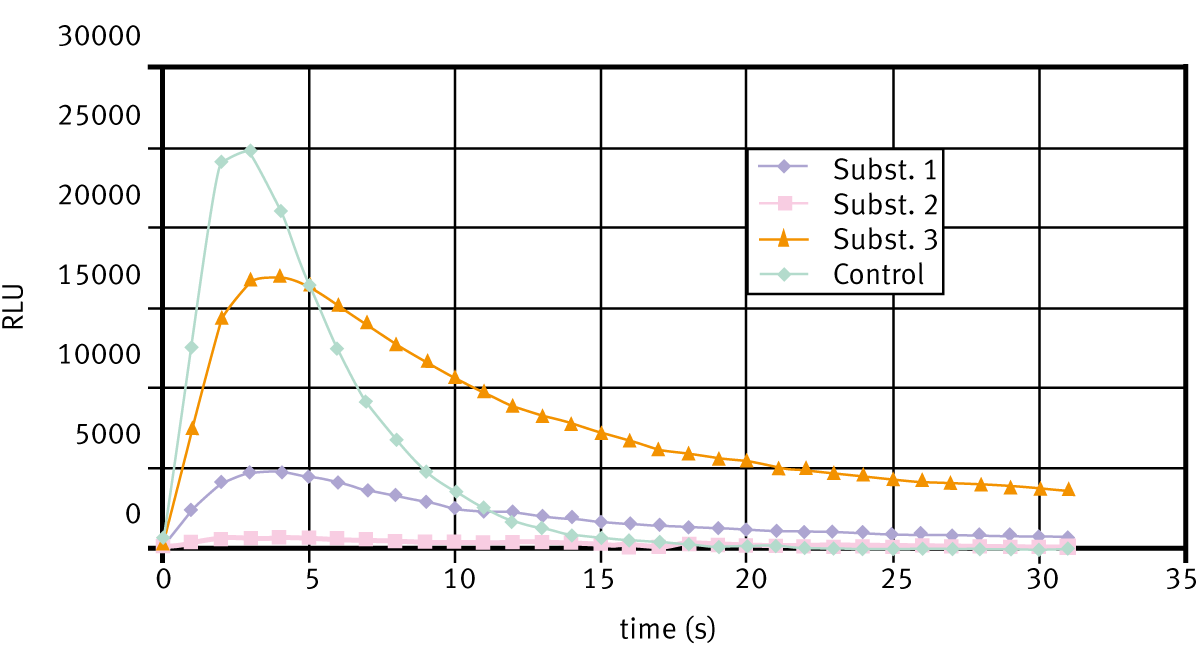
These substances were prepared from natural plant extracts. Compared with the control (100%) scavenging of superoxide could be detected.
The inhibition amounted 32%, 80%, and 97%, respectively. It is possible to quantify the antioxidant capacity of unknown substances by means of the ascorbate standard curve (Fig. 3).

Conclusion
The ABEL® Antioxidant test kit with Pholasin® can be used successfully for measurements of substances with unknown antioxidant capacity.
With a BMG LABTECH microplate reader with luminescence detection and injectors, the test can be done very fast and with a high precision and reproducibility.
ABEL is a registered trademark of Knight Scientific Ltd.