



A microplate that Looks out of a microplate Reader A microplate that Looks out of a microplate Reader

High‑Performance Fluorescence Polarization Microplate Readers

Our fluorescence polarization plate readers are engineered for high‑performance, precise molecular interaction analysis and high‑throughput screening. Designed for binding assays, fragment screening and real‑time ...

Trusted and loved by:

customer-logos


The features of our Fluorescence Polarization readers

  • Fluorescence polarization plate reader with best available sensitivity 
  • Good resolution of even small assay windows thanks to lowest mP standard deviations 
  • Simultaneous Dual Emission detects two polarization channels simultaneously
  • Compatible with microplate formats up to 1536-wells for high-throughput
  • Fast detection of kinetic events
  • Precise temperature control for stable reactions
  • Injectors to start/stop reactions
  • Fluorescence measurement capability included, upgradable absorbance and luminescence
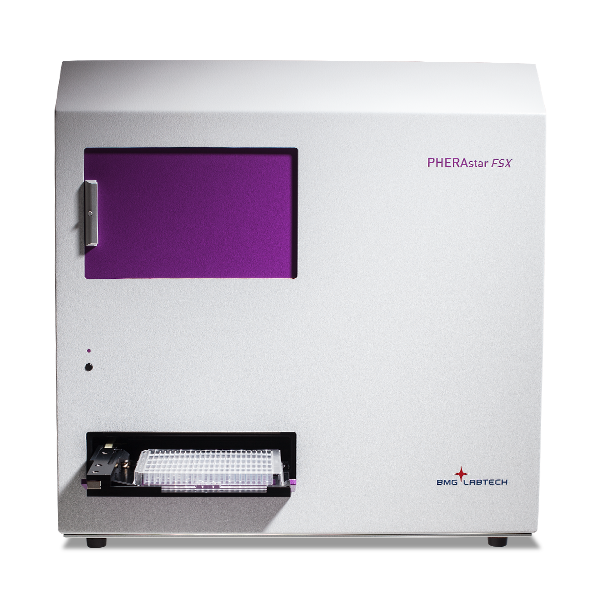
The PHERAstar FSX: an example for a fluorescence polarization plate reader

The PHERAstar FSX: an example for a fluorescence polarization plate reader

Application Notes

See how scientists and researchers are using BMG Labtech’s instruments for fluorescence polarization applications:

Frequently asked questions

  • What is fluorescence polarization?

    Fluorescence polarization (FP), also known as fluorescence anisotropy, is a technique that measures the rotational mobility of fluorescently labelled molecules in solution. When a small tracer is excited with plane‑polarized light, it tumbles rapidly and emits largely depolarized light; when the same tracer binds to a larger molecule such as a protein or antibody, its rotation slows and the emitted light remains more polarized. This change in polarization is reported in millipolarization (mP) units and is used to monitor binding events, enzyme activity and molecular interactions in real time.
  • How does a fluorescence polarization plate reader work?

    A fluorescence polarization plate reader uses an optical system with polarizing filters to excite samples with plane‑polarized light and then measure the emitted light through parallel and perpendicular polarizers. The instrument calculates polarization typically expressed in mP, where high mP values indicate bound, slowly rotating complexes and low mP values indicate free, fast‑tumbling tracers. This allows homogeneous, no‑wash assays in microplate formats, ideal for high‑throughput screening and kinetic binding studies.
  • What are the main applications of fluorescence polarization microplate readers?

    Fluorescence polarization microplate readers are widely used for competitive binding assays and Kd determination, fragment‑based and small‑molecule screening in drug discovery, and protein–protein, protein–DNA and protein–ligand interaction studies. They are also applied in enzyme assays where substrate or product binding changes molecular size, as well as for real‑time monitoring of complex formation or dissociation. These applications benefit from FP’s homogeneous, no‑wash format, low sample consumption and compatibility with 96‑, 384‑ and 1536‑well plates.
  • What microplate format is best for fluorescence polarization assays?

    Fluorescence polarization assays are commonly run in 96‑, 384‑ and 1536‑well black, low‑volume plates to reduce background fluorescence and crosstalk. Plate choice depends on assay volume, throughput requirements and the need for compatibility with liquid handling and automation systems. Optimising sample volume and well geometry helps maximise signal‑to‑noise and assay robustness on a fluorescence polarization microplate reader.
Newsletter Sign-up