





Introduction
P-glycoprotein (Pgp; ABCB1), a member of the ATP-binding cassette (ABC) superfamily, exports structurally diverse hydrophobic compounds from the cell driven by ATP hydrolysis. Pgp expression has been linked to the efflux of chemotherapeutic drugs in human cancers leading to multidrug resistance. Pgp activity can also result in low oral absorption and poor brain penetration. Interaction of drugs with the Pgp may also cause an increase in toxicity of co-administered compounds.
Interaction of drugs with active transporters such as Pgp is of increasing interest to the pharmaceutical industry based, in large part, on new draft FDA guidelines requiring knowledge of whether a drug candidate is a substrate and/or inhibitor of Pgp.
The Fluorosome Company’s Fluorosome®-trans-pgp assay, together with BMG LABTECH’s microplate readers, provide a rapid, sensitive, and specific reconstituted Pgp liposome assay system for identification of compounds that interact with the transporter. The assay measures the ability of a compound to compete with a Pgp substrate for transport and determines the IC50 value. The reader’s ability to inject at the point of measurement assures that no data is lost. Up to 50 readings per second taken concurrently upon injection, provide sample data for calculation of first order transport rates. Single concentration inhibition measurements can be made very rapidly, and an IC50 determination carried out in only 10 minutes thereby.
Assay Principle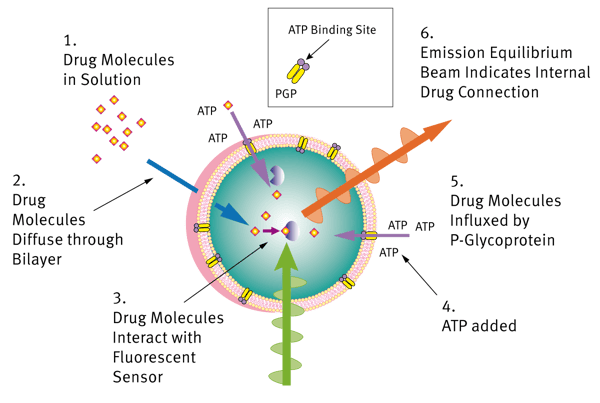 Materials & Methods
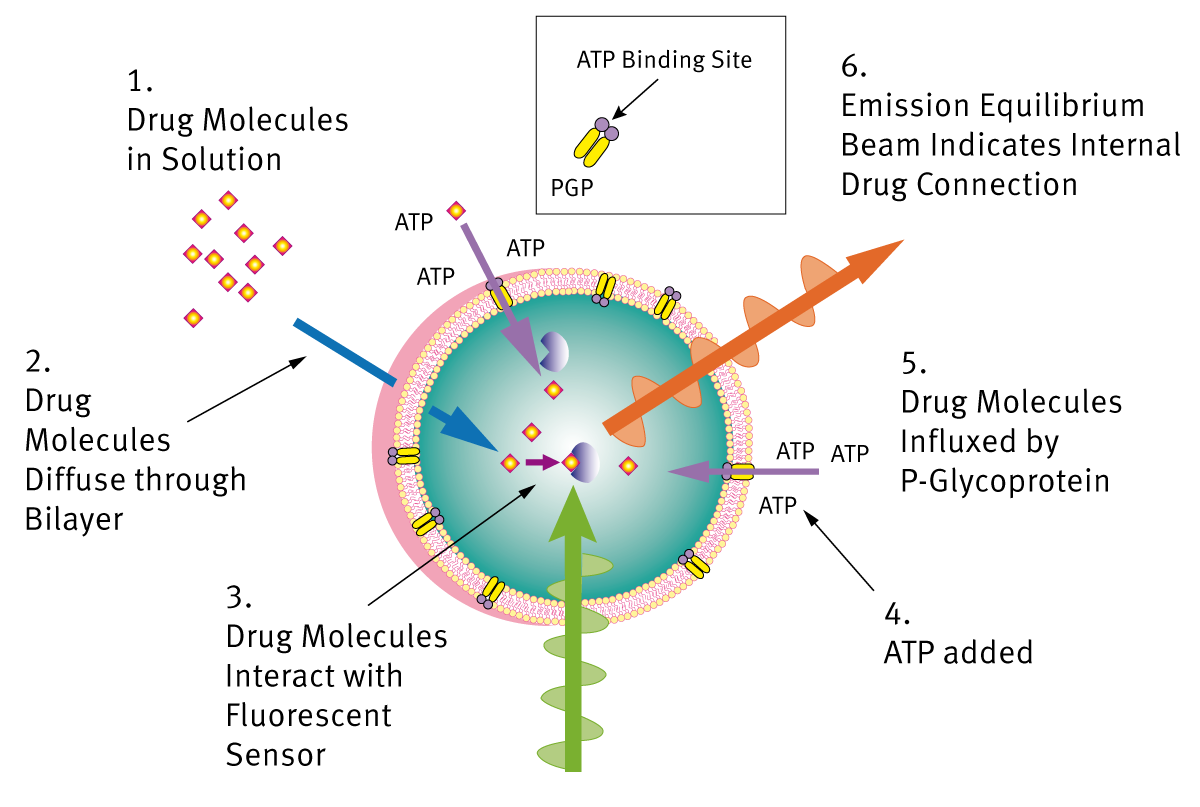
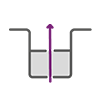
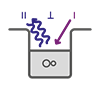
The Pgp is a 170 kDa intrinsic membrane protein that effluxes a wide range of drugs from the cell. Pgp is also an outwardly directed flippase for fluorescent phospholipid and glycosphingolipid derivatives, which suggests that it may also translocate drug molecules from the inner to the outer membrane leaflet. The membrane lipid bilayer plays an important role in Pgp function and may regulate both binding and transport of drugs.
Isolation and Purification of Pgp
Purified Pgp (>90%) is isolated from Pgp-over-expressing CHRB30 cells by detergent (CHAPS) extraction followed by affinity chromatography on Con A-Sepharose. Micellar Pgp is reconstituted into lipid bilayers by mixing in solution with CHAPS-solubilized micellar phospholipid, and the detergent is removed by gel exclusion chromatography. The resulting reconstituted Pgp is aliquoted and stored frozen at -70°C.
Manufacture of Fluorosome-trans-pgp
Frozen reconstituted Pgp is thawed and mixed in buffer with fluorophore (BSA-fluorescein) then converted into Fluorosome-trans-pgp by extrusion. The resulting uni-lamellar vesicles are separated from unencapsulated fluorophore by gel exclusion chromatography. The fluorosome-trans-pgp is then subjected to Quality Control Criteria; size, fluorescence, passive permeability, and ATP-stimulated transport of a control Pgp substrate.
The Fluorosome-trans-pgp assay procedure
-
98 μl of Fluorosome-trans-pgp in buffer containing 3 μM of the substrate S-HR was added to each well of a 96-well half-well plate.
-
A 2 μl aliquot of a DMSO solution of test compound was added. Each aliquot contained test compound at one of 7 concentrations to give, after dilution into the well, the desired concentration of compound. Blank, reference wells (no compound) had 2 μl of DMSO added to them.
-
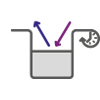
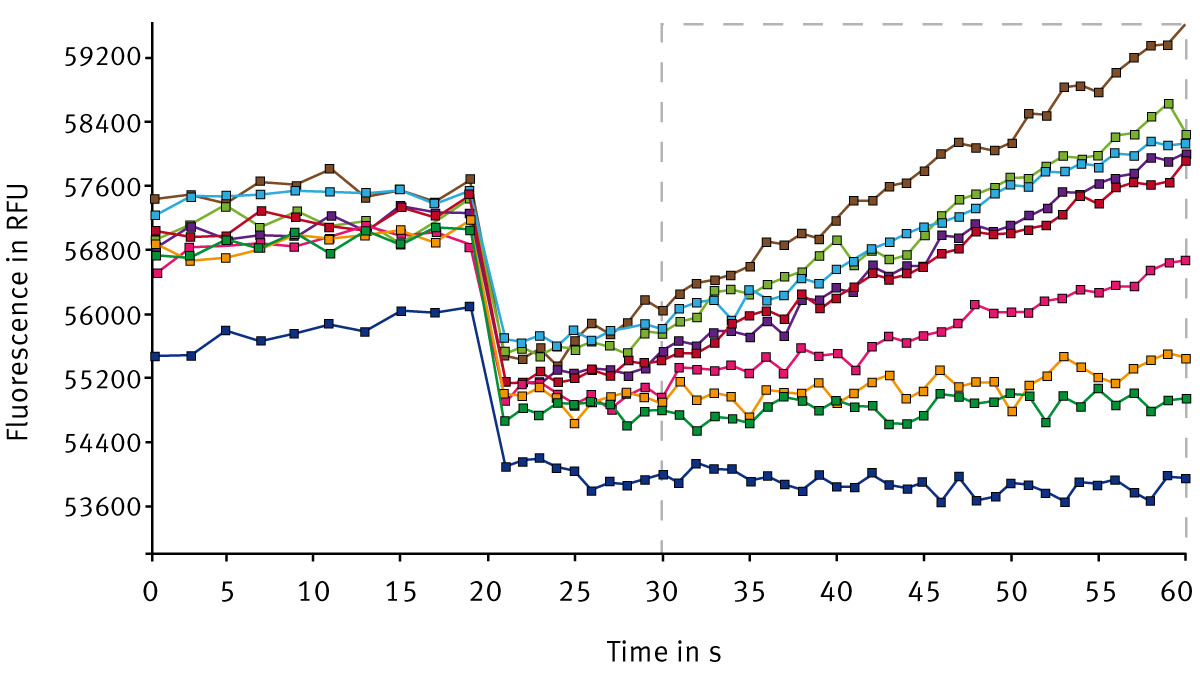
The plate was placed in the microplate reader, and the fluorescence was monitored at 485/520 for 60 seconds as follows:
-
a fluorescence baseline was established during the first 18 seconds;
-
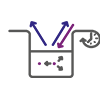
at 18 seconds, 5 μl of a solution of ATP in buffer was injected into each well (final concentration 2 mM), and the fluorescence was monitored for 42 seconds;
-
The slope from 30 to 60 seconds was immediately calculated by BMG LABTECH’s MARS data analysis software.
A typical picture of fluorescence signals measured over time is given in Figure 2.
Results & Discussion
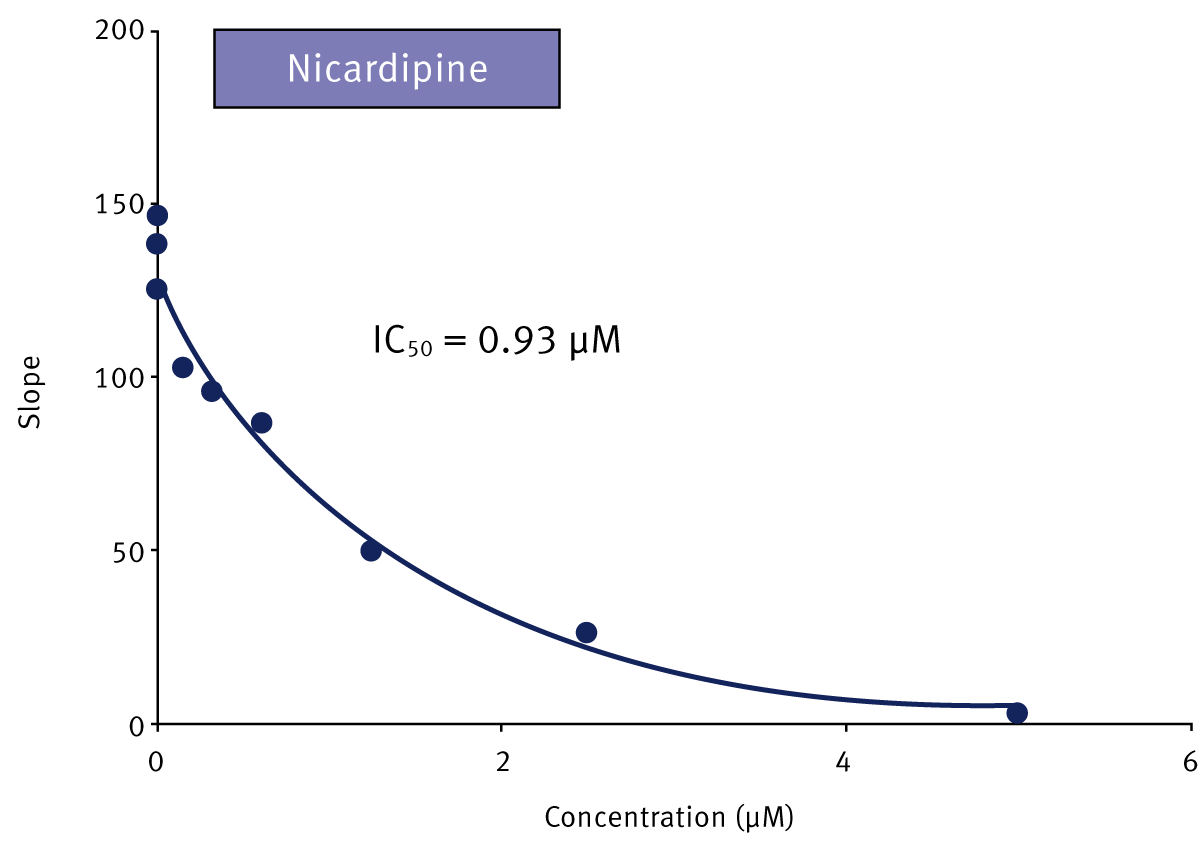
The slope for each well (Fig. 2) was plotted against concentration of test compound, and IC50 values were calculated by using a robust fit for a single order decay (Fig. 3 and 4).
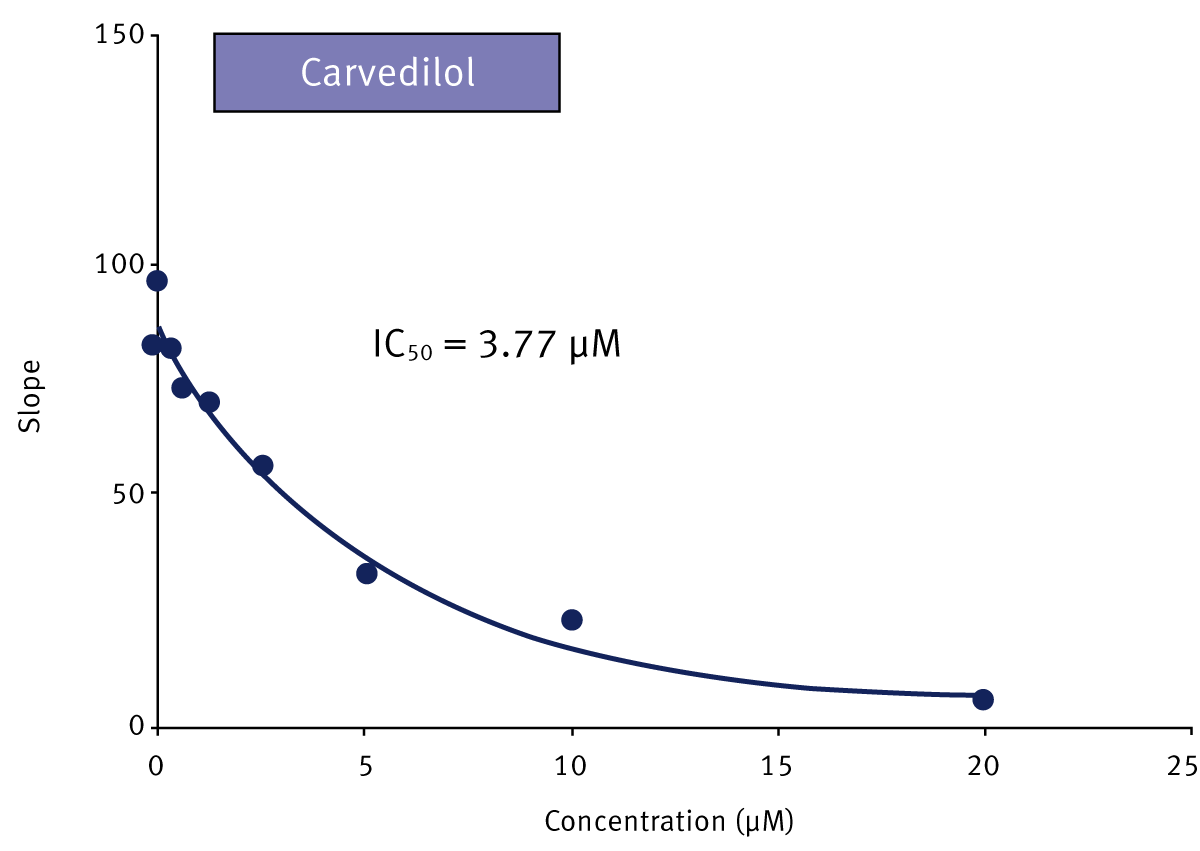
Correlation of Fluorosome-trans-pgp IC50 Data and Cell Monolayer IC50 Data
IC50 values are given as μM concentrations. Bidirectional transport inhibition studies were conducted on the same set of compounds as were measured with the Fluorosome-trans-pgp assay, examples of which are shown in Fig. 5. Bidirectional transport inhibition studies employed LLC-MDR1 cell monolayers and [3H] digoxin (0.1 μM) as the substrate.

Results using the Fluorosome-trans-pgp assay are in excellent agreement with those obtained by cell culture methodology.
Conclusion
We report a novel assay specific for measuring inhibition of the P-glycoprotein multidrug transporter (Pgp; ABCB1) and an ideal instrument for its use.
-
Simple assay procedure: No sterile conditions, non-compound specific, no radiolabel or LC-mass spectroscopy
-
Specificity: Fluorosome®-trans-pgp contains only the P-glycoprotein transporter
-
Low Sample Requirement: A 100 μl volume of Fluorosome®-trans-pgp Reagent per assay requires 1 nanomole drug
-
Speed: 1 minute per inhibition assay - e.g. an 8 point IC50 determination + 2 references takes only 10 minutes
-
Popular format: 96 well half-well or 384 well microplates - one well per inhibition assay