

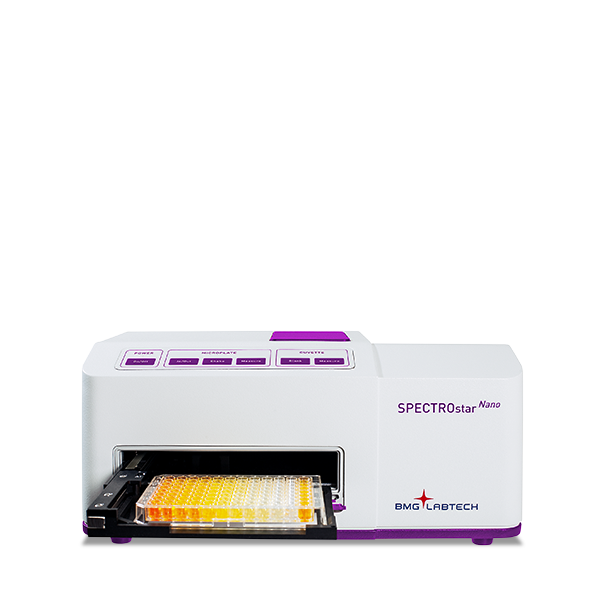
Enzyme-linked immunosorbent assays or ELISAs are a popular tool to detect or measure biological molecules in the life sciences. Explore in detail how ELISA microplate readers can advance your research.


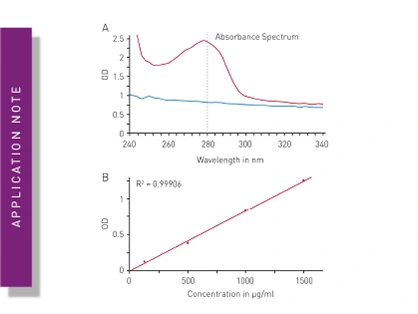
UV/vis absorbance spectra
Endpoint and kinetic
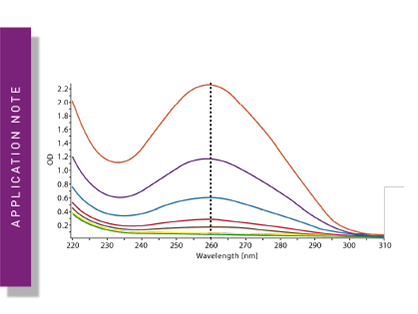
Spectral scanning (absorbance)
Well scanning
6 to 1536-well plates, user-definable
LVis Plate with 16 low-volume microspots (2 μL)
Robot compatible
High energy xenon flash lamp
CCD Spectrometer
UV/vis absorbance spectrometer
Full spectra or 8 distinct wavelengths in < 1 sec/well
220 - 1000 nm; wavelength precision: ≤ 0.5 nm
Selectable spectral resolution: 1, 2, 5, and 10 nm
OD range: 0 to 4 OD; photometric resolution: 0.001 OD
Accuracy: < 1% at 2 OD
Precision: < 0.5% at 1 OD and < 0.8% at 2 OD
Linearity: ≤ 0.8% at 2.0 OD
Full spectrum from 220 to 1000 nm in less than 1 sec/well
Linear, orbital, and double-orbital with user-definable time and speed
System to inject an atmosphere or to pull a vacuum into the reader
+3 °C above ambient up to 45 °C
The upper heating plate of the incubation chamber operates at 0.5 °C more than the lower plate. This prevents condensation build-up on the lid or sealer
Multi-user Reader Control and MARS Data Analysis Software included
FDA 21 CFR Part 11 compliant
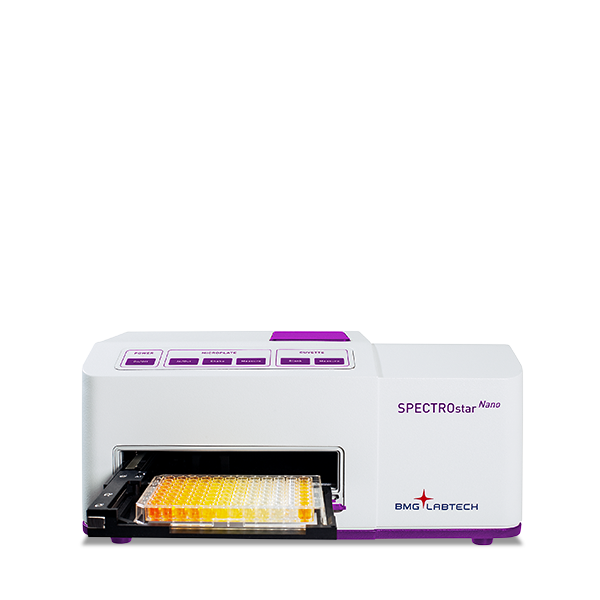
Width: 36 cm, depth: 50 cm, height: 16 cm; weight: 10 kg
Sample capacity: sixteen separate microdrop wells for 2 µL samples; one standard cuvette position for up to 1 mL samples
Quality control internal standards (optional): four NIST traceable optical density filters (approximate values of 0.1, 0.3, 0.6 and 1.0 OD); one holmium oxide filter for wavelength accuracy
Dimensions: conforms to SBS standards for microplates
Microplate incubator and shaker
See how scientists and researchers are using BMG Labtech’s instruments for ELISA-based experiments.