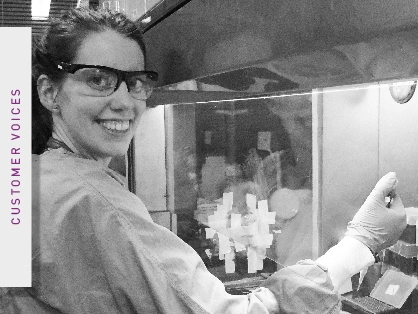
Using the POLARstar OPTIMA in parabolic flights.
The research group of Prof. Dr. Rüdiger Hampp and Dr. Maren Neef tries to find an answer to the question: How do plants know where top and bottom are? Already known are light and gravity as the two most important factors. To investigate these effects independently it is necessary to knock off one of the parameters. This is not a problem for light but what can be done to knock off gravity? The answer is a parabolic flight. During such a flight, different stages of gravitation are obtained, ranging from hypergravity (about 1.8 g) to microgravity (about 10-3 g). In one flight, 31 parabolas are flown.
Novespace, a French company, performs these flights:

http://www.novespace.fr/fr,popup,parabole.html
http://www.youtube.com/watch?v=Lhu198E8z2U
Plants are sensitive to changes in gravity. To investigate the signaling pathway from the stimulus (no gravity) to the response (e.g. activation or deactivation of the expression of certain genes) the level of two important second messengers, Ca2+ and hydrogen peroxide, were monitored. Two transgenic cell lines derived from Arabidopsis thaliana expressing either Cameleon (a calcium sensor) or HyPer (an H2O2 sensor) were used as well as a wild type. The calcium and hydrogen peroxide measurements were performed on a fixed POLARstar OPTIMA in kinetic mode during the whole time of the parabolic flight. Some results for calcium level measurements can be found below:


1g stands for usual gravity. 1.8 g stands for gravity 80% higher than normal.
The period of microgravity (µg) lasted for about 22 seconds.
The calcium levels were found to increase with microgravity and decreased afterwards. Further parabolic flights with the POLARstar OPTIMA on board are in preparation.
These experiments are financed by a grant from the Deutsches Zentrum für Luft- und Raumfahrt (DLR; 50WB0723).
For more information about the Tubinger research group please have a look here:
http://www.bbp.uni-tuebingen.de/index.php5?object=Content.ResearchTopics.GravitationBiology